
Last updated: June 23, 2026
Quick Answer: The AirPods Pro 3 include genuine hearing health tools — a built-in hearing test, a clinical-grade hearing aid feature, and active hearing protection up to 110 dBA — that set them apart from any previous earbuds. But these features don’t eliminate risk on their own. How loud you listen, how long you wear them, and whether you actually use the protection features still determines whether your ears stay healthy.
Key Takeaways
- 🎧 AirPods Pro 3 include an integrated hearing test that runs directly through the earbuds and delivers personalized results
- 🔊 A clinical-grade hearing aid feature is built in, designed for mild to moderate hearing loss and customizable via audiogram data
- 🛡️ Active hearing protection reduces loud environmental noise up to 110 dBA across all listening modes [1]
- 📉 Active Noise Cancellation removes up to twice as much background noise as previous AirPods Pro models [3]
- 🔋 Battery life reaches 10 hours with the hearing aid feature enabled — a 67% improvement over prior models [1]
- ⚠️ Convenience features can still lead to overexposure if volume habits aren’t managed
- 💰 Launched at $249 in September 2025; as of June 2026, available for around $199 at Amazon [4]
- 👂 Anyone with existing hearing concerns should consult an audiologist before relying solely on the built-in hearing aid feature
What Makes AirPods Pro 3 Different for Hearing Health?
AirPods Pro 3 are the first mainstream earbuds to bundle clinical hearing health tools directly into a consumer audio product. Apple integrated three distinct hearing features: a hearing test, a hearing aid mode, and active hearing protection — all managed through the iPhone.
The integrated hearing test lets users check their hearing without a clinic visit. Results feed directly into the hearing aid feature, which amplifies sounds in a way that’s customized to the user’s specific hearing profile [1]. This is a meaningful step beyond simple volume limiting.
For context on why this matters, understanding how wireless earbuds can affect hearing over time is essential before deciding whether any new features actually change your risk.
How Does the Built-In Hearing Aid Feature Actually Work?
The hearing aid feature in AirPods Pro 3 is designed for people with perceived mild to moderate hearing loss. It amplifies environmental sounds and can be fine-tuned using either the results from the built-in hearing test or an audiogram from a licensed audiologist [2].
Key points about setup and use:
- The feature works across all listening modes, including when music is playing
- Customization is done through iPhone settings, not a separate app
- An audiologist’s audiogram can be uploaded for more precise calibration
- Dr. Cliff, AuD, has published a detailed tutorial on setting this up correctly for best results [5]
Choose this feature if: You’ve noticed difficulty hearing conversations in noisy environments but haven’t yet sought formal hearing care. It’s a practical bridge — not a replacement for professional evaluation.
Common mistake: Skipping the hearing test or audiogram upload and using default settings. Default amplification may not match your actual hearing profile, reducing the feature’s effectiveness.
Does Active Noise Cancellation Actually Protect Your Ears?
Yes — and this is one of the clearest hearing health benefits of upgrading. Better ANC means you don’t need to raise volume to compete with background noise, which is one of the most common causes of hearing damage.
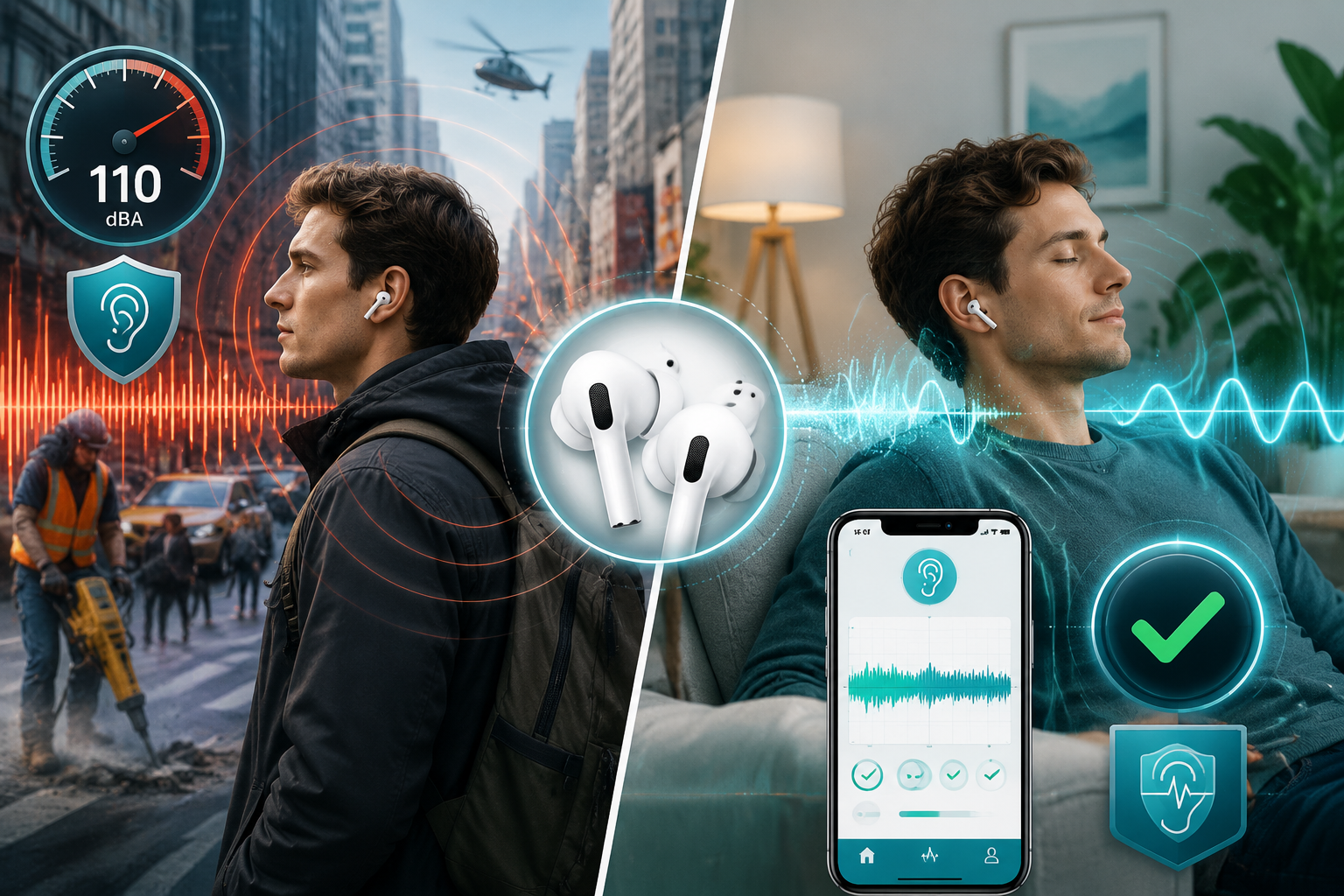
AirPods Pro 3 deliver the strongest in-ear ANC available, blocking up to twice as much background noise as the previous generation [3]. The active hearing protection feature specifically targets loud environmental sounds, reducing exposure to noise levels up to 110 dBA [1].
Here’s why that number matters:
| Noise Level | Example | Risk Without Protection |
|---|---|---|
| 85 dBA | Heavy city traffic | Damage after ~2 hours |
| 100 dBA | Subway train | Damage after ~15 minutes |
| 110 dBA | Live concert | Damage in under 2 minutes |
With active hearing protection enabled, the AirPods Pro 3 act as a buffer against sudden loud sounds — something passive eartips alone can’t reliably do.
Can You Still Damage Your Hearing With AirPods Pro 3?
Absolutely. The features reduce risk, but they don’t remove it. This is the most important nuance in the AirPods Pro 3 and hearing health conversation before upgrading.
The two biggest ongoing risks:
- Listening volume: ANC reduces the urge to turn up volume, but many users still listen at unsafe levels out of habit. Apple’s iPhone includes a feature that tracks headphone audio levels and warns when weekly exposure exceeds safe thresholds — use it.
- Duration of use: Wearing earbuds for 6–8 hours daily, even at moderate volume, accumulates exposure. The World Health Organization recommends keeping personal audio device use to under 1 hour per day at 60% volume as a general guideline.
If you’re already noticing symptoms like ringing in the ears or muffled sound after listening sessions, that’s a warning sign worth taking seriously — not something to manage with more technology alone.
Who Benefits Most From Upgrading to AirPods Pro 3 for Hearing Health?
Not everyone needs to upgrade for hearing health reasons. Here’s a practical breakdown:
Strong reasons to upgrade:
- You have mild to moderate hearing loss and want a discreet, everyday amplification option
- You work or commute in consistently loud environments (above 85 dBA)
- You want to track hearing changes over time with built-in testing
- You currently turn volume up high to hear over background noise
Upgrade less critical if:
- Your hearing is healthy and you already practice safe listening habits
- You own AirPods Pro 2 and use ANC consistently
- Budget is a concern — the $199 price point is lower than it was at launch [4], but it’s still a significant investment
For seniors or anyone managing age-related hearing changes, the hearing aid feature may offer real daily value. See our guide on hearing health strategies for seniors for broader context.
What Safe Listening Habits Still Apply, Even With AirPods Pro 3?
The AirPods Pro 3 and hearing health features are tools — habits are what make them effective. Technology doesn’t replace behavior.
Safe listening checklist:
- ✅ Keep volume at or below 60% for everyday listening
- ✅ Use ANC in noisy environments instead of raising volume
- ✅ Enable iPhone’s headphone audio level notifications
- ✅ Take listening breaks — at least 5 minutes per hour in loud environments
- ✅ Run the built-in hearing test at least once a year
- ✅ If you notice early signs of hearing damage, consult an audiologist promptly
The Personalized Volume feature in AirPods Pro 3 also adjusts audio automatically based on environment and listening history [1], which helps reduce unconscious volume creep. Enable it.
How Do the AirPods Pro 3 Hearing Features Compare to Traditional Hearing Aids?
The hearing aid feature in AirPods Pro 3 is FDA-cleared for mild to moderate hearing loss, which puts it in the same regulatory category as over-the-counter hearing aids. But there are meaningful differences.
| Feature | AirPods Pro 3 | Traditional Hearing Aid |
|---|---|---|
| Cost | ~$199–$249 | $1,000–$6,000+ per pair |
| Customization | Self-fit via app/audiogram | Professionally programmed |
| Discretion | Consumer earbuds | Purpose-built device |
| Music/calls | Full audio functionality | Limited |
| Battery life | Up to 10 hours (hearing aid mode) [1] | Varies widely |
| Professional follow-up | Not included | Typically included |
Bottom line: AirPods Pro 3 are a practical, affordable option for people with mild to moderate hearing loss who want one device for both audio and amplification. They are not a substitute for professionally fitted hearing aids in cases of moderate-to-severe loss.
For those exploring dedicated hearing solutions, our overview of hearing aids available through Amazon covers accessible options at various price points.
Conclusion
The AirPods Pro 3 represent a genuine step forward in consumer hearing health — not just marketing. The integrated hearing test, clinical-grade hearing aid feature, and active hearing protection at 110 dBA are real, functional tools that can reduce hearing risk and support people with mild hearing loss in their daily lives [1][2][3].
But the honest answer to “do AirPods Pro 3 protect your hearing?” is: only if you use them correctly. Better ANC reduces the temptation to crank volume. Active hearing protection guards against sudden loud sounds. The hearing aid feature can meaningfully improve quality of life for those with mild to moderate loss. None of that matters if volume habits stay unsafe or if you ignore early warning signs.
Actionable next steps before upgrading:
- Run a baseline hearing check — either through the AirPods Pro 3 setup or with an audiologist
- Review your current listening habits using iPhone’s headphone audio level data
- Enable ANC and active hearing protection from day one — don’t leave them off
- Set a reminder to re-run the hearing test every 6–12 months
- If you notice ringing, muffled sound, or difficulty with speech clarity, seek professional evaluation rather than adjusting device settings
For a broader look at how earbuds affect ear health over time, the guide on AirPods and hearing health is a strong companion read to this one.
Frequently Asked Questions
Are AirPods Pro 3 FDA-cleared as hearing aids? Yes. The hearing aid feature in AirPods Pro 3 is FDA-cleared for adults with perceived mild to moderate hearing loss. It’s not approved for severe or profound hearing loss [2].
Can the AirPods Pro 3 hearing test replace a professional audiogram? No. The built-in test provides a useful baseline and can calibrate the hearing aid feature, but it doesn’t replace a comprehensive audiological evaluation, especially for medical diagnosis or complex hearing loss [2].
How loud is too loud when using AirPods Pro 3? Sustained listening above 85 dBA increases hearing damage risk over time. iPhone’s headphone notifications flag when weekly exposure exceeds safe levels — this is the most practical tool for monitoring volume habits.
Does active hearing protection work while listening to music? Yes. Active hearing protection operates across all listening modes, including during music playback, reducing sudden loud environmental sounds up to 110 dBA [1].
What’s the battery life with the hearing aid feature on? Up to 10 hours on a single charge with the hearing aid feature enabled — a 67% improvement compared to previous AirPods Pro models [1].
Is the $199 Amazon price a good time to buy? As of June 2026, $199 matches the record-low price for AirPods Pro 3 at Amazon [4]. If the hearing health features align with your needs, it’s a reasonable entry point.
Can children use the hearing aid feature? The hearing aid feature is designed and FDA-cleared for adults. Children with hearing concerns should be evaluated by a pediatric audiologist.
Do AirPods Pro 3 help with tinnitus? There’s no dedicated tinnitus masking feature, but the hearing aid amplification and ANC can reduce the contrast that makes tinnitus more noticeable. For dedicated tinnitus support, see our guide on advanced hearing aids for tinnitus relief.
References
[1] Hearing Health – https://www.apple.com/airpods-pro/hearing-health/?utm_source=openai [2] Support Apple – https://support.apple.com/en-us/120992?utm_source=openai [3] Introducing AirPods Pro 3: The Ultimate Audio Experience – https://www.apple.com/newsroom/2025/09/introducing-airpods-pro-3-the-ultimate-audio-experience/?utm_source=openai [4] AirPods Pro 3 Just Got a Record Low Price Cut at Amazon – https://www.techradar.com/audio/earbuds-airpods/airpods-pro-3-just-got-a-record-low-price-cut-at-amazon-but-you-may-want-to-hold-off-buying-for-now?utm_source=openai [5] Watch (Dr. Cliff AuD AirPods Pro 3 Hearing Aid Setup Tutorial) – https://www.youtube.com/watch?v=20JhqLhJvwc&utm_source=openai
