
Last updated: July 15, 2026
Quick Answer: Hearing loss is one of the most common invisible disabilities worldwide, and the everyday audio tech most people use without thinking, earbuds, headphones, and speakers, can either deepen that disability or help manage it. Used at safe volumes with the right features, these devices improve accessibility. Used carelessly, they cause or accelerate permanent hearing damage. The difference often comes down to volume, duration, and device choice.
Key Takeaways
- 🔊 One in five teenagers already shows signs of hearing damage, roughly 30% more than 20 years ago, largely linked to earbud and headphone use [8]
- 📊 The “60/60 rule” (60% volume, max 60 minutes at a time) is the most widely recommended starting point for safe listening [8][9]
- 🎧 Noise-cancelling headphones can actually protect hearing by reducing the urge to turn up volume in noisy environments [1]
- 🦻 Hearing aid compatibility varies widely between devices, look for the “M” and “T” ratings before buying
- 🦴 Bone conduction headphones are a genuine alternative for people with certain types of hearing loss
- ⚠️ Wireless earbuds can interfere with hearing aids, but modern Bluetooth 5.0+ devices have largely reduced this problem
- 💡 Expensive headphones don’t automatically protect hearing better, volume habits matter far more than price
- 🔇 Speakers used at safe distances and volumes are generally safer than in-ear devices for people with hearing loss
- 🛑 Permanent noise-induced hearing damage is irreversible, prevention is the only cure
- ✅ Built-in volume limiting and sound exposure tracking tools (available on iOS, Android, and many modern devices) are free and effective
What Causes Hearing Loss From Earbuds and Headphones
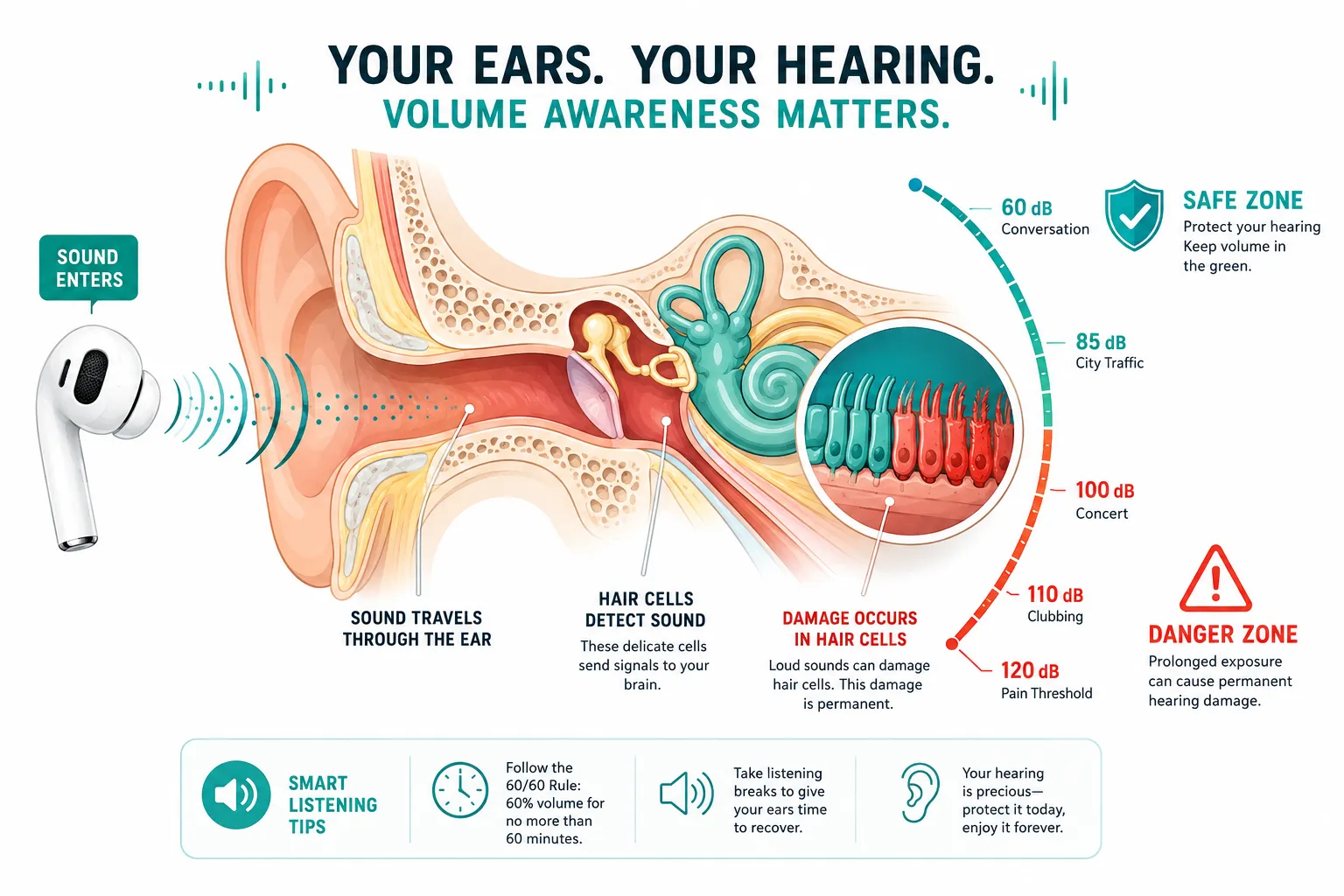
Earbuds and headphones cause hearing loss by delivering loud sound directly into the ear canal, exposing the delicate hair cells of the inner ear (cochlea) to sustained high-decibel pressure. These hair cells do not regenerate once damaged, making the hearing loss permanent.
The mechanism is straightforward: sound above roughly 85 decibels (dB) causes cumulative damage over time. At 100 dB, a common volume level for in-ear earbuds in a noisy environment, safe exposure time drops to under 15 minutes. A 2025-2026 clinical study found measurable sensorineural hearing loss (SNHL) in 3.6% of participants who regularly used headphones, most showing a characteristic 4-6 kHz “noise notch” that is the hallmark of noise-induced damage [3].
Key risk factors:
- Listening at high volumes (above 80 dB average)
- Using in-ear earbuds, which sit close to the eardrum
- Listening in noisy environments and turning up volume to compensate
- Extended sessions without breaks
- Starting heavy headphone use in childhood or adolescence
For a deeper look at how noise damages hearing structures, see Understanding Hearing Damage: Causes, Prevention, and Solutions.
How Loud Is Too Loud, and What Volume Level Prevents Hearing Damage
Any sustained exposure above 80 dB average is considered unsafe for regular listening. The World Health Organization advises keeping personal audio devices below 60% of maximum volume and below an 80 dB average [1][10].
The “60/60 rule” is the practical shortcut: stay at or below 60% of maximum volume, and limit continuous listening to 60 minutes before taking a break [8][9]. Most smartphones now display a warning when volume exceeds safe thresholds, don’t dismiss it.
Rough decibel reference points:
| Sound | Approx. dB | Safe Exposure Time |
|---|---|---|
| Normal conversation | 60 dB | Unlimited |
| Busy restaurant | 75 dB | Unlimited |
| Earbuds at 60% volume | ~75-80 dB | Up to 8 hours |
| Earbuds at 80% volume | ~90-95 dB | Under 1 hour |
| Earbuds at max volume | ~105-110 dB | Under 5 minutes |
Researchers found that volume regulation is more critical than duration alone, even short bursts at very high volumes cause measurable damage [3].
Can You Damage Your Hearing Permanently From Headphones
Yes, and the damage is irreversible. Noise-induced hearing loss (NIHL) destroys cochlear hair cells that cannot regrow. Global data show that 24% of people aged 12-35 listen at unsafe levels [9], and a national study found that approximately 5.2 million children and adolescents in the US have permanent hearing damage tied to excessive noise exposure, much of it from earbuds and headphones [9].
Otologists note that headphone-linked hearing loss is increasing among teenagers, and that repeated loud exposure is the direct cause [8]. Early signs include tinnitus (ringing in the ears) after listening sessions, difficulty understanding speech in noisy places, and sounds seeming muffled after use.
For more on recognizing early warning signs, see Recognizing Hearing Loss Symptoms: A Complete Guide.
What’s the Difference Between Noise-Cancelling and Hearing Protection
Noise-cancelling headphones and hearing protection devices serve different purposes, though they overlap in one key benefit: both reduce the amount of external noise reaching your ears.
Active Noise Cancellation (ANC) uses microphones and processing to generate an opposing sound wave that neutralizes ambient noise. This lets users listen at lower volumes in noisy settings, a real hearing health benefit. However, ANC headphones are not rated hearing protection devices and should not be used as substitutes in genuinely hazardous noise environments (construction sites, concerts, etc.).
Hearing protection (earplugs, earmuffs) is rated by Noise Reduction Rating (NRR) and is designed specifically to block sound. It does not amplify or process audio.
Choose noise-cancelling headphones if: you want to enjoy music safely on a commute or in a busy office. Choose rated hearing protection if: you’re in a workplace or event with sustained noise above 85 dB.
For a detailed comparison, see Noise-Cancelling vs Regular Headphones: Which Are Better for Your Hearing. Also, noise-cancelling headphones have shown benefits beyond hearing, read about Noise-Cancelling Headphones and Anxiety: Can Quieter Soundscapes Help.
Best Hearing Aid Compatible Earbuds and Headphones
Hearing aid compatible (HAC) audio devices are rated using M (microphone coupling) and T (telecoil coupling) ratings. Devices rated M3/M4 or T3/T4 produce less radio frequency interference and work better alongside hearing aids.
What to look for:
- M3 or M4 rating for reduced RF interference
- T3 or T4 rating if your hearing aid has a telecoil
- Over-ear or on-ear designs rather than in-ear, which can physically conflict with behind-the-ear (BTE) hearing aids
- Bluetooth 5.0 or higher for more stable, lower-interference wireless connections
- Made for iPhone (MFi) or ASHA (Audio Streaming for Hearing Aids) certification for direct streaming
For a comprehensive guide to choosing the right device, see Best Headphones for Hearing Loss: How to Choose Audio Devices That Work.
Can Wireless Earbuds Interfere With Hearing Aids
Yes, wireless earbuds can interfere with hearing aids, but modern devices have largely reduced this problem. Older Bluetooth devices operating at 2.4 GHz could cause buzzing or static in hearing aids. Bluetooth 5.0+ devices use frequency-hopping and lower transmission power, significantly reducing interference.
Practical tips to minimize interference:
- Keep wireless earbuds and hearing aids at least a few inches apart when both are active
- Test in-store before purchasing if possible
- Use earbuds specifically designed for hearing aid users (some brands offer open-fit designs)
- Consider over-ear headphones, which sit away from hearing aid microphones
For specific device guidance, see Apple AirPods Pro 3 and Hearing Aid Users: Best Settings.
Are Bone Conduction Headphones Better for Hearing Loss
Bone conduction headphones can be a strong option for specific types of hearing loss, but they’re not universally better. These devices sit on the cheekbones and transmit sound vibrations directly to the cochlea, bypassing the outer and middle ear entirely.
Best suited for:
- People with conductive hearing loss (damaged outer or middle ear, intact cochlea)
- Users who need to stay aware of environmental sounds
- People whose hearing aids physically conflict with standard headphones
Less effective for:
- Sensorineural hearing loss (damaged cochlea), since bone conduction still relies on cochlear function
- High-fidelity audio, sound quality is generally lower than traditional headphones
Edge case: Some people with single-sided deafness find bone conduction useful for routing sound to the functioning ear. See Understanding Hearing Loss in One Ear: Causes, Symptoms & Solutions for more context.
How to Use Speakers Safely If You Have Hearing Loss
Speakers are generally safer than in-ear earbuds for people with hearing loss because sound is distributed through open air rather than directed into the ear canal. The key variables are distance and volume.
Safe speaker use guidelines:
- Keep portable Bluetooth speakers at least 1-2 meters away from your ears during extended listening
- Avoid placing speakers on nightstands or desks directly at ear level for long periods
- Use volume levels where normal conversation is still possible without shouting
- Take 10-minute breaks after every hour of listening [1][10]
For detailed guidance on portable Bluetooth speaker safety, see Portable Bluetooth Speakers and Hearing Safety: Listening Without Risk.
Accessibility Features for Deaf and Hard of Hearing in Audio Devices
Modern audio devices include a growing range of accessibility tools that can meaningfully improve daily life for people with hearing loss. These features represent one of the clearest ways that disability, hearing loss, and everyday tech intersect for the better.
Built-in accessibility features to look for:
- Live Listen / Remote Mic mode (Apple, Android): turns a phone into a remote microphone that streams directly to hearing aids or earbuds
- Sound Recognition (iOS, Android): alerts users to important sounds (doorbells, alarms, crying babies) via haptic or visual notifications
- Real-time captions: Google’s Live Transcribe and Apple’s Live Captions convert speech to text in real time
- Customizable EQ and frequency boosting: allows users to amplify the specific frequency ranges where their hearing is weakest
- Volume limit controls and sound exposure tracking: available natively on iOS (Hearing section of Health app) and Android (Headphone Safety in Sound settings)
- Mono audio mode: routes both stereo channels to one ear, essential for single-sided hearing loss
AI tools are also playing a growing role in hearing accessibility, see AI Tools Transforming Diagnosis and Treatment of Hearing Loss for what’s emerging in 2026.
How Often Should You Take Breaks From Wearing Earbuds
The WHO recommends taking at least a 10-minute break after every hour of loud sound exposure [1][10]. For earbuds specifically, this applies both to hearing health and to ear canal comfort, prolonged in-ear use can also contribute to earwax buildup and moisture-related issues.
Practical break schedule:
- After 60 minutes of listening: 10-minute break minimum
- After any session that felt loud: rest ears for 15-20 minutes
- In genuinely noisy environments (concerts, flights): limit total exposure and use noise-cancelling headphones to avoid compensatory volume increases
Do Expensive Headphones Protect Your Hearing Better Than Cheap Ones
No, price does not directly determine hearing safety. What matters is volume habit, fit, and whether the headphones include features like active noise cancellation (which reduces the need to turn up volume).
A $30 pair of noise-cancelling headphones used at 60% volume is safer than $400 open-back audiophile headphones cranked to 90%. That said, higher-quality headphones often:
- Have better ANC, reducing background noise and the temptation to raise volume
- Fit more comfortably, encouraging proper seal and lower listening levels
- Include sound exposure monitoring tools
Choose expensive headphones if: you want better ANC, comfort, and built-in safety features. Choose budget headphones if: you’re disciplined about volume, the ears don’t know the price tag.
For budget-friendly options designed with hearing health in mind, see Wireless Speakers, Earbuds, and Headphones: A Complete Buyer’s Guide.
What’s the Safest Way to Listen to Music With Existing Hearing Problems
For people already living with hearing loss, the safest approach combines lower volume, better device choice, and regular monitoring. Disability, hearing loss, and everyday tech intersect most critically here, the wrong habits can accelerate an already progressing condition.
Step-by-step safe listening protocol:
- Set a volume ceiling: use your device’s built-in volume limit to cap output at 60-70% of maximum
- Choose over-ear noise-cancelling headphones over in-ear earbuds where possible
- Use sound exposure apps (Apple Health, SoundPrint, NIOSH SLM) to monitor actual dB levels
- Take breaks every 45-60 minutes, more frequently if you have existing damage
- Get an annual hearing check, track whether your audiogram is changing
- Consult an audiologist about custom EQ settings that boost your specific weak frequencies without raising overall volume
💬 “Volume regulation is more critical than duration alone in reducing risk.”, Clinical study on headphone use and sensorineural hearing loss, 2025-2026 [3]
Conclusion: Making Everyday Tech Work For, Not Against, Your Hearing
Disability, hearing loss, and everyday tech are inseparable in 2026. The same earbuds that help a hard-of-hearing person stream captions directly to their ears can, if misused, push a teenager closer to permanent damage. The difference is almost always volume, duration, and awareness.
Actionable next steps:
- ✅ Check your device’s volume limit settings today and cap them at 60%
- ✅ Enable sound exposure tracking in your phone’s health app
- ✅ If you use hearing aids, verify your earbuds or headphones carry M3/M4 or T3/T4 ratings
- ✅ Switch to over-ear noise-cancelling headphones for commuting or working in noisy spaces
- ✅ Book a hearing check if you haven’t had one in the past year, especially if you notice tinnitus after listening sessions
- ✅ Explore accessibility features like Live Listen, mono audio, and real-time captions
Hearing loss is often invisible, but its causes and prevention are not. Small, consistent choices about how audio tech is used make a measurable difference, and the tools to make those choices are already in most people’s hands.
FAQ
Q: Can earbuds cause tinnitus? Yes. Loud earbud use is a common trigger for tinnitus (ringing in the ears). Even temporary tinnitus after a listening session is a warning sign of noise stress on the cochlea. See Understanding Tinnitus: The Complete Guide for more.
Q: Is it safe to sleep with earbuds in? No. Sleeping with earbuds increases the risk of ear canal irritation, earwax impaction, and prolonged low-level noise exposure. It also prevents the ear recovery that happens during quiet rest.
Q: Are wireless earbuds safer than wired earbuds for hearing? Neither is inherently safer, both deliver sound directly to the ear canal. The risk comes from volume, not the cable. Wired earbuds have no Bluetooth interference risk, but hearing damage risk is identical at the same volume.
Q: What’s the safest type of headphone for a child? Over-ear headphones with a built-in volume limit (85 dB max) are the safest choice for children. Many brands market these specifically for kids. Avoid in-ear earbuds for young children.
Q: Can I use earbuds if I have a hearing aid? It depends on your hearing aid type. In-ear earbuds physically conflict with in-canal hearing aids. Over-ear headphones or bone conduction devices are generally more compatible. Check HAC ratings (M3/M4, T3/T4) before purchasing.
Q: Does noise-cancelling actually protect hearing? Indirectly, yes. ANC reduces background noise, so users don’t need to raise volume to hear clearly. This lower listening volume reduces cumulative noise exposure. ANC is not a substitute for rated hearing protection in hazardous environments.
Q: How do I know if my hearing has been damaged by headphones? Common signs include ringing or buzzing after listening (tinnitus), muffled sound that takes time to clear, and difficulty understanding speech in noisy places. A formal audiogram from an audiologist is the only way to confirm damage.
Q: Are there headphones designed specifically for people with hearing loss? Yes. Several brands offer amplified headphones, hearing-loop compatible models, and devices with customizable frequency amplification. An audiologist can recommend options matched to your specific audiogram.
References
[1] Deafness And Hearing Loss Safe Listening – https://www.who.int/news-room/questions-and-answers/item/deafness-and-hearing-loss-safe-listening
[3] Pmc12704010 – https://pmc.ncbi.nlm.nih.gov/articles/PMC12704010/
[8] Are Bluetooth Headphones Bad For You Yes If You Constantly Crank Them Up Doctors Say – https://www.thestar.com.my/tech/tech-news/2026/07/14/are-bluetooth-headphones-bad-for-you-yes-if-you-constantly-crank-them-up-doctors-say
[9] Earbuds And Hearing Loss – https://www.mayoclinichealthsystem.org/hometown-health/speaking-of-health/earbuds-and-hearing-loss
[10] Mls Brochure English 2021 – https://cdn.who.int/media/docs/default-source/documents/health-topics/deafness-and-hearing-loss/mls-brochure-english-2021.pdf?sfvrsn=bf19b448_5
