Last updated: July 14, 2026
Quick Answer: Acoustic trauma from loud events happens when intense sound damages the delicate hair cells inside your inner ear. If your ears are ringing or muffled after a concert, fireworks, or a sudden noise blast, leave the loud environment immediately, rest your hearing for 24-48 hours, and monitor your symptoms closely. If significant hearing loss or ringing persists beyond 48-72 hours, seek medical care urgently, ideally within that window, as early treatment dramatically improves recovery odds. [4][5]
Key Takeaways
- 🎵 Concerts and fireworks can exceed 100-120 dB, well above the safe threshold of 80 dB for adults [3]
- ⏱️ The 72-hour window after exposure is critical; early treatment gives the best chance of recovery [4]
- 🔇 Leave the loud environment immediately and avoid all loud noise for at least 24-48 hours [7]
- 💧 Rest, hydration, good sleep, and avoiding alcohol and caffeine support ear recovery [1][7]
- 🔔 Ringing that fades within 1-2 days is usually temporary; ringing or muffled hearing that persists beyond 48-72 hours warrants urgent specialist evaluation [5]
- 🚨 Red-flag symptoms, one-sided severe hearing loss, ear pain, bleeding, spinning vertigo, or pulsatile tinnitus, require emergency care [5][8]
- 🎧 Earplugs with a noise reduction rating (NRR) of at least 25 dB can prevent acoustic trauma at future events [6]
- 🏥 No dedicated clinical guidelines exist specifically for acoustic trauma, but steroid therapy within 72 hours is a recognized treatment option for confirmed threshold shifts [4]
What Is Acoustic Trauma and How Does It Happen?
Acoustic trauma is injury to the inner ear caused by exposure to extremely loud sound, either a single sudden blast or a sustained high-volume event. It damages or destroys the tiny hair cells in the cochlea (the snail-shaped organ in your inner ear) that convert sound vibrations into nerve signals your brain can interpret.
These hair cells do not regenerate in humans. Once enough of them are destroyed, the hearing loss they cause is permanent. A single exposure to sound above 140 dB, like a gunshot or a close-range firework blast, can cause instant, irreversible damage. Prolonged exposure to levels above 85-100 dB, such as a two-hour rock concert, can cause a measurable temporary or permanent threshold shift. [3][4]
How it happens, step by step:
- Loud sound creates intense pressure waves in the ear canal
- These waves over-stimulate the cochlear hair cells
- Hair cells become fatigued or physically damaged
- The auditory nerve receives distorted or no signal
- You perceive this as muffled hearing, ringing (tinnitus), or both
Acoustic trauma from loud events, whether a concert, firework show, or sudden noise blast, is one of the most common yet preventable causes of hearing damage worldwide. [3]
What Are the Signs of Acoustic Trauma?
The most common signs appear immediately or within minutes of the loud exposure. Recognizing them early is the first step in responding correctly.
Common symptoms:
- Ringing, buzzing, or hissing in one or both ears (tinnitus)
- Muffled or “underwater” quality to sounds
- Temporary reduction in hearing clarity or volume
- A feeling of fullness or pressure in the ear
- Difficulty understanding speech in a noisy environment
Serious symptoms that need immediate medical attention:
- Sudden, severe hearing loss in one ear [5]
- Sharp ear pain or a sensation that something “popped”
- Bleeding from the ear canal
- Spinning vertigo or loss of balance
- Tinnitus that pulses in time with your heartbeat (pulsatile tinnitus)
- Discharge from the ear [8]
For a broader overview of what nerve-level damage can feel like, see this guide to symptoms of ear nerve damage.
What Should I Do Right After Exposure to Loud Noise?
Act within the first few minutes and hours. The steps you take immediately after acoustic trauma from a loud event can meaningfully affect how well your hearing recovers.
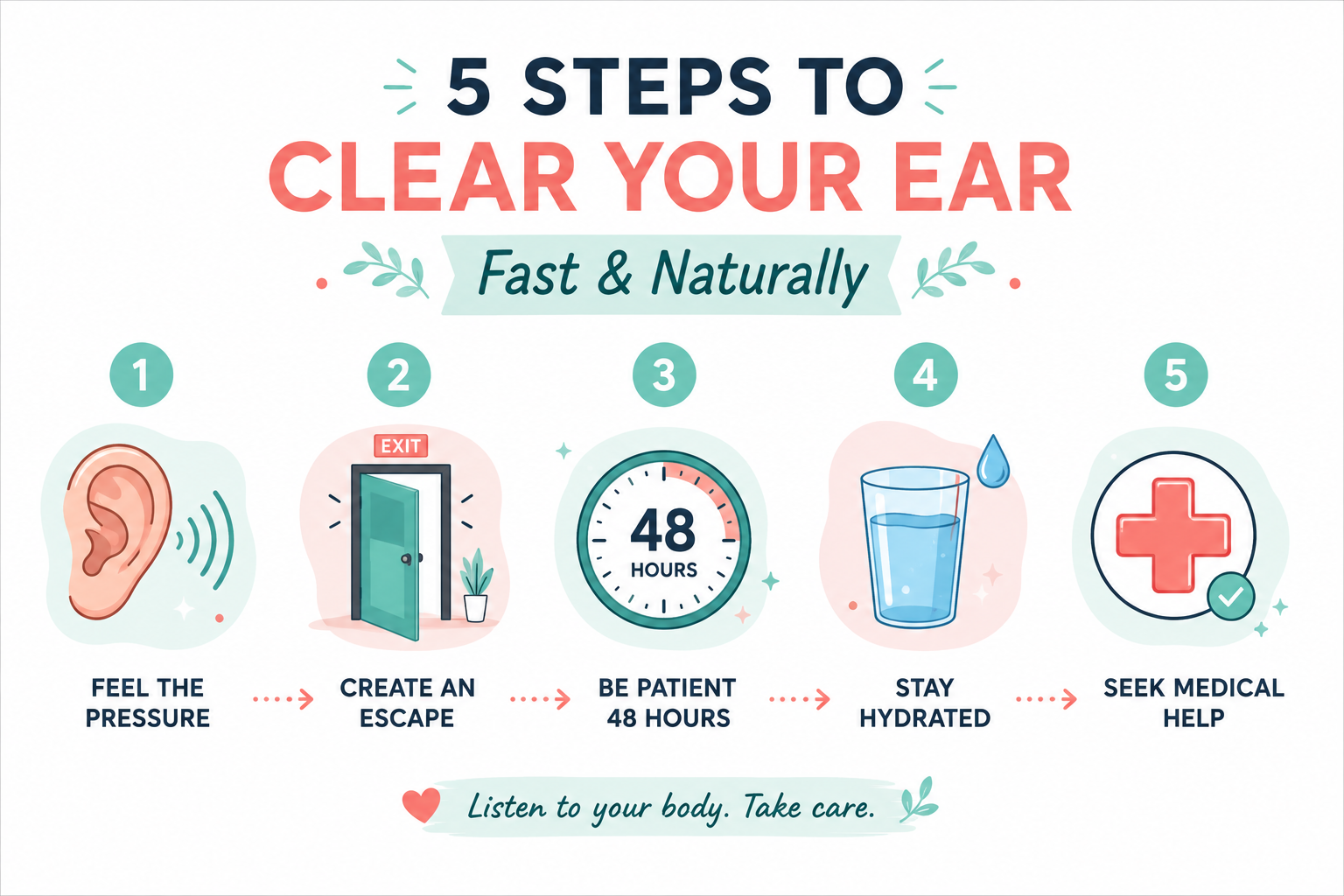
Your Immediate Response Plan (First 24 Hours)
Step 1, Leave the loud environment now Move away from the noise source immediately. Every additional minute of exposure adds more damage. [9]
Step 2, Do not insert anything into your ears Avoid cotton swabs, fingers, or any object. If there is bleeding or discharge, cover the outer ear loosely with a clean cloth and go to an emergency room. [8]
Step 3, Give your ears complete acoustic rest Avoid headphones, earbuds, loud music, TV at high volume, and any noisy environment for at least 24-48 hours. [7][9]
Step 4, Use gentle background sound if tinnitus is distressing Complete silence can actually make ringing seem louder. A soft fan, white noise machine, or quiet ambient audio at low volume helps mask tinnitus without causing further damage. [1][7]
Step 5, Hydrate and rest Drink water, get good sleep, and avoid alcohol, caffeine, and nicotine, all of which can worsen tinnitus and slow recovery. [1][7]
Step 6, Monitor your symptoms for 48-72 hours Track whether ringing and muffled hearing are improving, staying the same, or getting worse. This timeline matters for medical decisions. [5]
Step 7, Seek medical care if symptoms persist or worsen If there is no clear improvement by 48-72 hours, contact an ENT (ear, nose, and throat specialist) or audiologist urgently. [4][5]
How Loud Is Too Loud? Understanding the Decibel Danger Zone
Sound is measured in decibels (dB). The relationship between volume and damage is not linear, every 3 dB increase roughly doubles the sound energy reaching your ears.
| Sound Source | Approximate dB Level | Risk Level |
|---|---|---|
| Normal conversation | 60 dB | Safe |
| City traffic | 85 dB | Caution (prolonged exposure) |
| Lawnmower | 90 dB | Risk after ~2 hours |
| Concert / club | 100-115 dB | Risk after minutes |
| Fireworks (close range) | 140-160 dB | Instant damage possible |
| Gunshot / explosion | 140-170 dB | Immediate danger |
The WHO-referenced safe listening limit is approximately 80 dB for adults and 75 dB for children. [3] Most concerts and fireworks displays exceed these levels significantly.
What’s the Difference Between Temporary and Permanent Hearing Loss?
Temporary hearing loss (also called a temporary threshold shift, or TTS) is a reversible reduction in hearing sensitivity that typically resolves within hours to a couple of days after a loud event. The hair cells are stressed and fatigued but not destroyed.
Permanent hearing loss (permanent threshold shift, or PTS) occurs when hair cells are actually damaged or killed. This does not reverse on its own and cannot currently be repaired. [3][4]
The key distinction: if your hearing and ringing return close to your normal baseline within 24-48 hours, the exposure likely caused only temporary stress. If symptoms persist or worsen beyond 48-72 hours, permanent damage is more likely and specialist evaluation is urgent. [5]
Important edge case: Repeated temporary threshold shifts, from going to concerts regularly without protection, can accumulate into permanent damage over time, even if each individual episode seems to resolve. [3]
For more on how cumulative noise exposure leads to lasting damage, see this comprehensive guide to understanding hearing damage.
How Long Does Temporary Hearing Loss Last After a Concert?
Temporary hearing loss and ringing after a concert typically resolve within 16-48 hours for most people, assuming no permanent damage occurred. [1][9]
What a normal recovery looks like:
- 0-6 hours: Ringing and muffled hearing are most intense
- 6-24 hours: Gradual improvement in most cases
- 24-48 hours: Hearing should be close to baseline
The concerning pattern to watch for [5]:
- Minimal improvement at 24 hours
- Persistent loud ringing and muffled hearing at 48 hours
- Little or no improvement by 72 hours
This pattern should trigger immediate evaluation by an ENT or audiologist. Do not wait longer hoping it will resolve on its own.
Is Tinnitus After Loud Events Permanent?
Tinnitus after a single loud event is often temporary and resolves within 1-2 days. However, if ringing does not improve within 48-72 hours, there is a meaningful risk that it has become chronic. [5][7]
Tinnitus becomes more likely to be permanent when:
- The exposure was extremely loud (above 140 dB, such as a close-range blast)
- Multiple loud events have occurred over a lifetime without protection
- Symptoms are worsening rather than improving after 48 hours
- It is accompanied by measurable hearing loss on audiometry
For a deeper look at tinnitus causes, patterns, and management options, the complete guide to tinnitus covers the full picture. There are also innovative tinnitus treatments worth exploring if symptoms persist.
Can Hearing Loss from Loud Noise Be Reversed?
Temporary threshold shifts can reverse on their own with rest and time. Permanent hearing loss from destroyed cochlear hair cells cannot currently be reversed, there is no approved therapy that regenerates these cells in humans. [3][4]
However, early medical intervention can sometimes limit the extent of permanent damage:
- Steroid therapy: For confirmed acute acoustic trauma with a measurable threshold shift greater than 25 dB at three consecutive frequencies, high-dose oral or transtympanic (through-the-eardrum) steroids are recommended when not contraindicated, ideally started within 24-72 hours of the event. [4]
- Audiometric monitoring: Weekly hearing tests after the injury help track recovery and guide treatment decisions. [4]
- Sudden sensorineural hearing loss (SSNHL) protocols: Sudden dramatic hearing loss after a loud event is treated as a medical emergency using the same protocols as spontaneous SSNHL, because the treatment window is similarly narrow. [4][5]
Bottom line: You cannot undo damage that has already occurred, but acting within 72 hours gives the best chance of preserving as much hearing as possible.
When Should I See a Doctor for Hearing Damage?
See a doctor urgently, ideally within 24-72 hours, if symptoms do not clearly improve on their own. Do not wait for a routine appointment.
Go to an emergency room immediately if you have:
- Sudden, severe hearing loss in one ear [5]
- Ear bleeding or discharge [8]
- Spinning vertigo or inability to balance
- Intense ear pain
- Tinnitus that pulses with your heartbeat
See an ENT or audiologist within 24-48 hours if:
- Ringing or muffled hearing shows no improvement after 24 hours
- Hearing loss is noticeable but not severe
- You had a close-range fireworks or blast exposure
It is safe to monitor at home for up to 48 hours if:
- Symptoms are mild and clearly improving
- You have no pain, bleeding, vertigo, or one-sided hearing loss
- The event was a typical concert (not a blast or explosion)
If you experience sudden hearing loss in one ear specifically, read more about sudden deafness in one ear as a medical emergency.
Are There Treatments for Acoustic Trauma Damage?
There are no dedicated clinical guidelines specifically for acoustic trauma yet, but clinicians use a combination of established protocols. [4]
Current treatment approaches include:
- Oral corticosteroids (e.g., prednisone): First-line treatment for significant threshold shifts, started as early as possible within 72 hours [4]
- Transtympanic steroid injections: An option when oral steroids are not tolerated or have failed [4]
- Audiological monitoring: Regular hearing tests to track recovery trajectory [4]
- Sound therapy / tinnitus masking: Gentle background sound to reduce the perceived intensity of tinnitus during recovery [1][7]
- Surgery (tympanoplasty): For eardrum rupture from a blast, if the perforation does not heal on its own [8]
- Hearing aids or assistive devices: For permanent hearing loss that does not recover
What does NOT help:
- Inserting objects into the ear
- Using over-the-counter ear drops without medical advice
- Ignoring symptoms and hoping they resolve after the 72-hour window has passed
Does Rest Help Recover from Acoustic Trauma?
Yes, acoustic rest is one of the most evidence-supported self-care steps after noise exposure. Giving the auditory system a break from all loud input reduces ongoing stress on already-damaged hair cells and supports natural recovery processes. [7][9][10]
What acoustic rest means practically:
- No headphones or earbuds for at least 24-48 hours
- Keep TV and music at low volume
- Avoid crowded, noisy environments
- Sleep in a quiet room (or use a low-volume white noise machine if tinnitus makes silence uncomfortable)
Rest works best when combined with good hydration, sleep, and avoiding substances that constrict blood flow to the inner ear (alcohol, caffeine, nicotine). [1][7]
Can I Prevent Hearing Damage at Concerts and Fireworks?
Yes, and prevention is far more effective than any treatment. Most acoustic trauma from loud events is entirely avoidable with simple precautions.
At concerts:
- Wear earplugs with an NRR of at least 25 dB, musician-grade earplugs reduce volume without distorting sound quality [10]
- Stand at least 150 meters from speakers where possible [9]
- Take 10-15 minute quiet breaks during long shows [9][10]
- Avoid standing directly in front of speaker stacks
At fireworks:
- Stay at least 500 feet (about 150 meters) from the launch site [6]
- Use earplugs or earmuffs with NRR 25+ dB [6]
- Children should always wear hearing protection at fireworks displays [6]
- Choose quieter fireworks alternatives when organizing events [6]
For guidance on choosing the right hearing protection, this article on personalized fit-testing for hearing protection devices is a practical starting point.
Can Earplugs Really Protect from Hearing Damage?
Yes, properly fitted earplugs are highly effective. An earplug rated NRR 25 dB reduces the sound reaching your ear by roughly 12 dB in real-world conditions (the NRR is halved as a practical estimate). That reduction can bring a 110 dB concert down to approximately 98 dB, still loud, but significantly safer for a 2-hour show. [6][10]
Choose the right type:
- Foam earplugs: Cheap, widely available, effective but muffle sound quality
- Musician earplugs (flat-attenuation): Reduce volume evenly across frequencies, preserving sound clarity, best for concerts [10]
- Custom-molded earplugs: Best fit and protection for frequent concert-goers or musicians
Common mistake: Wearing earplugs incorrectly. Foam earplugs must be rolled, inserted deeply, and held in place while they expand. A poorly inserted earplug provides far less protection than its NRR rating suggests.
Is Acoustic Trauma the Same as Noise-Induced Hearing Loss?
Acoustic trauma and noise-induced hearing loss (NIHL) are closely related but not identical. Acoustic trauma typically refers to hearing damage from a single, very intense sound event. NIHL is a broader term that includes both single-event trauma and cumulative damage from repeated loud noise exposure over time. [3][4]
Both involve cochlear hair cell damage, both can cause tinnitus and threshold shifts, and both are largely preventable. The main practical difference is timeline: acoustic trauma is sudden and the medical response window is tight (72 hours), while NIHL from chronic exposure develops gradually and may not be noticed until significant damage has already occurred.
For a full breakdown of noise-induced hearing loss causes and prevention, the Cleveland Clinic’s overview is a reliable reference. [3]
Frequently Asked Questions
Q: My ears are ringing after a concert, should I be worried? A: Mild ringing that improves steadily over 24-48 hours is usually a temporary threshold shift and not a cause for alarm. If ringing is still loud or getting worse at 48 hours, see an audiologist or ENT promptly. [5][7]
Q: Can a single firework blast cause permanent hearing loss? A: Yes. Fireworks at close range can reach 140-160 dB, enough to cause instant, permanent damage. Eardrum rupture is also possible from the pressure wave. Seek emergency care if you experience severe pain, bleeding, or sudden hearing loss after a blast. [8]
Q: How do I know if my eardrum ruptured? A: Signs include sudden sharp pain, a feeling that something “popped,” bleeding or discharge from the ear, and a sudden drop in hearing. These require immediate emergency evaluation. [8]
Q: Should I use cotton balls to protect my ears after an injury? A: No. Do not insert anything into the ear canal after an acoustic injury. If there is discharge or bleeding, cover the outer ear loosely and go to an ER. [8]
Q: Does drinking water actually help after loud noise exposure? A: Hydration supports general circulation, including blood flow to the inner ear, which may aid recovery. It is a low-risk supportive measure, not a cure. [1][7]
Q: Can children recover from concert-related hearing damage faster than adults? A: Recovery varies with age and individual health. Children’s ears are not more resilient, in fact, they are more vulnerable. The same 72-hour response window applies, and children should always wear hearing protection at loud events. [4][6]
Q: Is it safe to wear headphones the day after a loud concert? A: It is best to avoid headphones entirely for at least 24-48 hours after any significant noise exposure to allow recovery. If you must use them, keep the volume very low. [7][9]
Q: What is pulsatile tinnitus and why is it a red flag? A: Pulsatile tinnitus is a rhythmic ringing or whooshing that pulses in time with your heartbeat. It can indicate vascular damage or other serious conditions and requires urgent medical evaluation, it is different from the steady ringing typical of acoustic trauma. [5]
Q: Can stress make tinnitus worse after a loud event? A: Yes. Stress and anxiety can amplify the perceived loudness of tinnitus. Relaxation techniques, gentle exercise, and good sleep hygiene can help manage this during the recovery period. [1]
Q: Are there supplements that help with acoustic trauma recovery? A: Some research has explored antioxidants (like N-acetylcysteine) for noise-induced hearing loss, but no supplement is currently approved or proven effective for acute acoustic trauma in humans. Consult a doctor before taking anything. [4]
Conclusion: Act Fast, Rest Well, and Protect Your Ears Going Forward
Acoustic trauma from loud events, whether a concert, firework show, or sudden noise blast, is a genuine medical situation that deserves a fast, structured response. The steps are straightforward: leave the noise immediately, rest your ears for 24-48 hours, avoid all loud sound and headphones, stay hydrated, and watch your symptoms carefully.
Your actionable next steps:
- Right now: Move away from any loud environment and begin acoustic rest
- Next 24-48 hours: No headphones, no loud environments, good sleep, no alcohol or caffeine
- At 48 hours: Honestly assess, are symptoms clearly improving? If not, call an ENT or audiologist today
- At 72 hours: If significant hearing loss or ringing persists, this is an urgent situation, do not wait
- Going forward: Invest in quality earplugs before your next concert or fireworks event
The 72-hour treatment window is real, and it closes fast. Acting quickly gives your hearing the best possible chance of recovery. And for every event after this one, a pair of well-fitted earplugs is the simplest investment you can make in a lifetime of healthy hearing.
References
[1] Tinnitus After Loud Events – https://hearinginsider.com/tinnitus-after-loud-events
[2] Ebm01061 – https://www.ebm-guidelines.com/go/ebm/ebm01061.html
[3] 21776 Noise Induced Hearing Loss Nihl – https://my.clevelandclinic.org/health/diseases/21776-noise-induced-hearing-loss-nihl
[4] Nbk609092 – https://www.ncbi.nlm.nih.gov/books/NBK609092/
[5] Why Your Ears Are Still Ringing Days After That Concert And When You Should Actually Worry – https://www.atmedica.com/why-your-ears-are-still-ringing-days-after-that-concert-and-when-you-should-actually-worry/
[6] Fireworks And Hearing Loss – https://americanhearing.us/fireworks-and-hearing-loss/
[7] Tinnitus Spikes After Loud Events A 48 Hour Recovery Plan – https://advancedhearingdocs.com/tinnitus-spikes-after-loud-events-a-48-hour-recovery-plan/
[8] Hearing Damage Due To Firecracker Blast – https://www.deventallergyvertigo.com/post/hearing-damage-due-to-firecracker-blast
[9] How To Stop Ringing In Ears From Concerts – https://www.bayaudiology.co.nz/hearing-health-blog/how-to-stop-ringing-in-ears-from-concerts
[10] Ears Ringing After A Concert Heres What You Need To Know – https://stanfordhearingaids.com/tinnitus/ears-ringing-after-a-concert-heres-what-you-need-to-know/
