
Last updated: July 1, 2026
Quick Answer: Personalized fit-testing for hearing protection devices is a structured process that measures how much noise reduction a specific earplug or earmuff actually provides to an individual worker, rather than relying on the manufacturer’s generic lab rating. NIOSH now recommends that employers use individual, quantitative fit-testing to generate a Personal Attenuation Rating (PAR) for each worker. [1] This approach closes the gap between what hearing protection should do on paper and what it actually does for each person.
Key Takeaways
- Generic earplug noise reduction ratings (NRR) are based on lab conditions and often overestimate real-world protection by a wide margin.
- Personalized fit-testing measures the actual attenuation a specific device provides to a specific individual, producing a Personal Attenuation Rating (PAR). [1]
- NIOSH recommends individual fit-testing as part of workplace hearing conservation programs. [1]
- Systems like the 3M E-A-Rfit™ [4] and HexArmor xact Fit™ [3] make portable, workplace-based testing practical in 2026.
- Fit-testing takes roughly 5–15 minutes per person and costs anywhere from free (employer-provided) to around $50–$150 for independent testing.
- People with small or unusually shaped ear canals benefit most from fit-testing, since standard earplugs often don’t seal properly.
- OSHA does not currently mandate fit-testing for most industries, but NIOSH strongly recommends it and some state-level programs are moving toward requiring it.
- Custom-molded earplugs can be fit-tested just like foam earplugs and often score higher PARs for consistent users.
- The most common mistake is inserting foam earplugs too shallowly, which dramatically reduces protection.
- Retesting is recommended whenever a worker changes earplug brand or style, gains or loses significant weight, or shows changes on an audiogram.
What Is Personalized Fit-Testing for Hearing Protection?
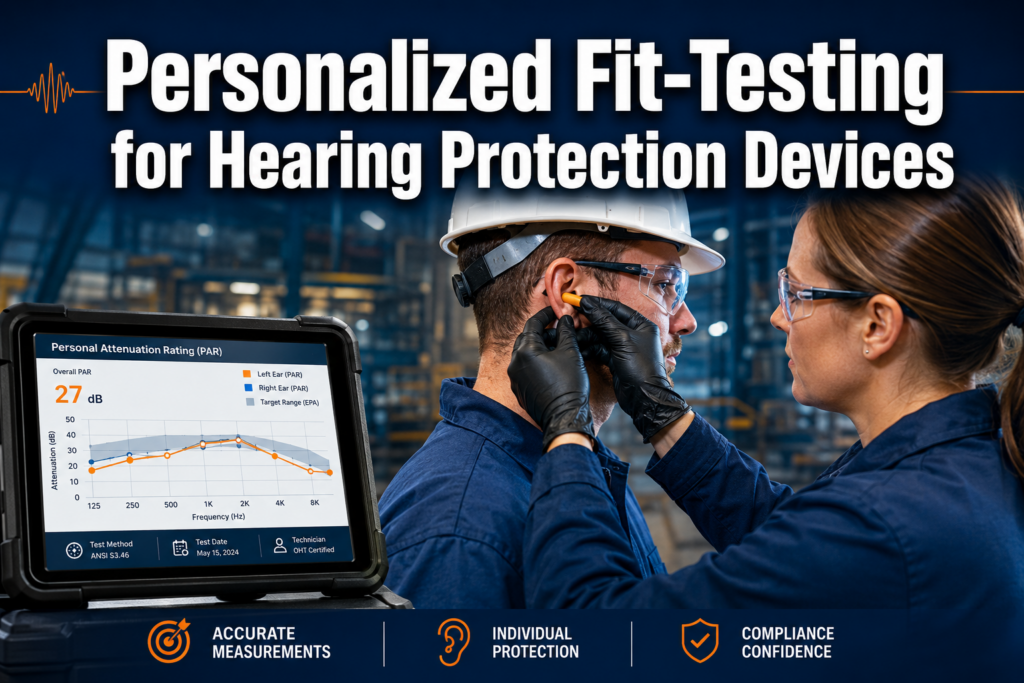
Personalized fit-testing for hearing protection devices is a measurement process that determines how much sound attenuation an individual person actually receives from a specific hearing protector when they insert or wear it themselves. The result is a Personal Attenuation Rating (PAR), expressed in decibels (dB). [1]
This is different from the Noise Reduction Rating (NRR) printed on earplug packaging. The NRR comes from controlled laboratory testing on trained subjects. Real workers in real workplaces rarely replicate those conditions, so the actual protection is often much lower.
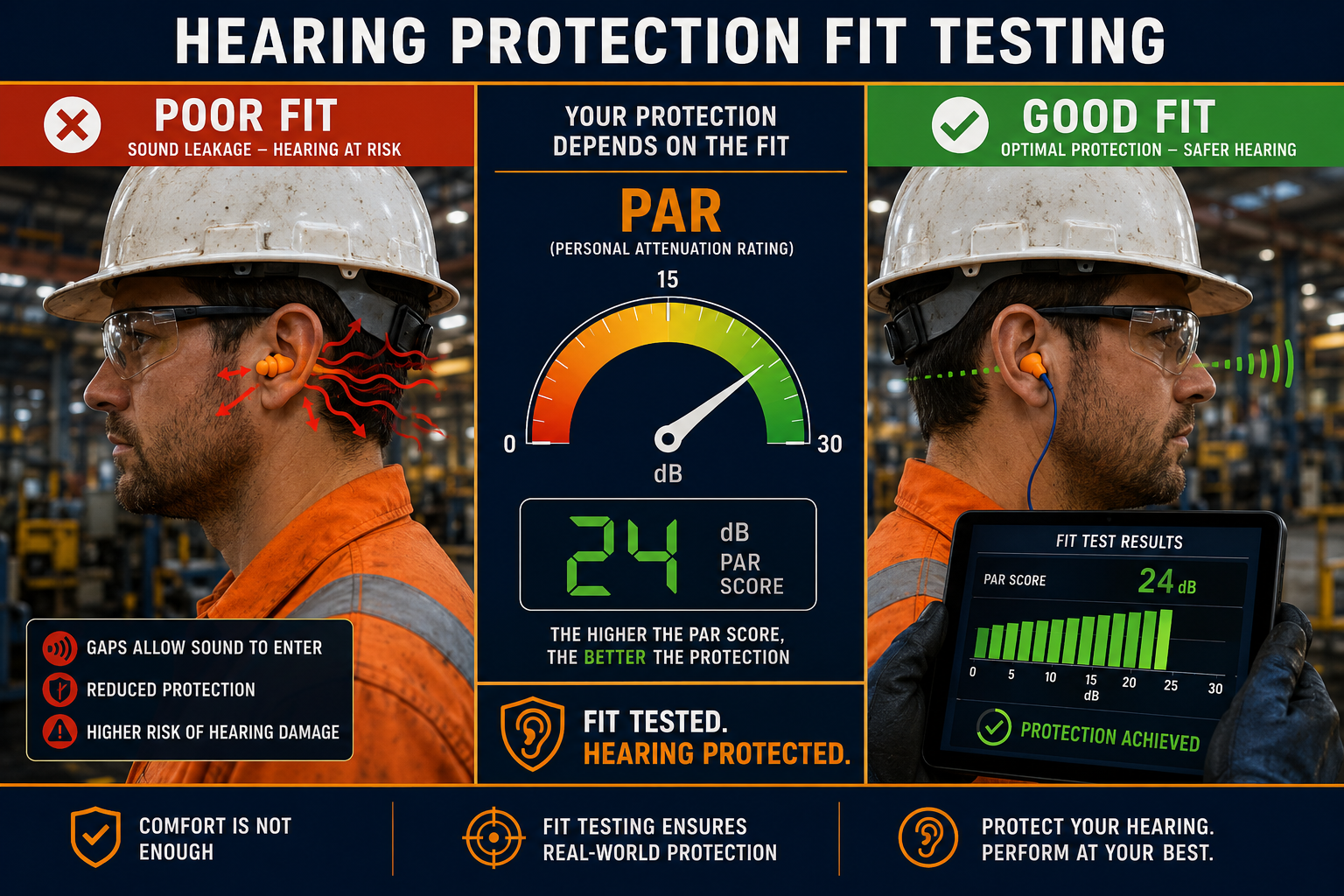
Why it matters: A worker who thinks their earplugs are blocking 29 dB of noise might only be getting 10–15 dB of real-world protection if the fit is poor. In loud environments, that gap can cause permanent hearing damage over time. Understanding hearing damage causes and prevention is the first step; ensuring protection actually works is the second.
How Does Fit-Testing for Earplugs Actually Work?
Fit-testing uses a microphone-in-real-ear (MIRE) or field attenuation estimation (FAES) method to compare sound levels inside and outside the ear canal while the worker wears their hearing protector.
Basic process:
- A small probe microphone is placed in the ear canal (or a sensor is placed at the ear).
- The worker inserts their earplug or puts on their earmuff as they normally would.
- A standardized noise signal plays through a speaker or headset.
- The system measures sound levels with and without the protector in place.
- The difference between those two measurements is the worker’s PAR. [1]
Modern systems make this fast and portable. The 3M E-A-Rfit™ Dual-Ear Validation System tests both ears simultaneously and generates a PAR report in minutes. [4] The HexArmor xact Fit™ uses Bluetooth headphones and a tablet, making it easy to deploy on a factory floor without a sound booth. [3] WAHTS offers a wireless system that meets OSHA and ANSI standards without traditional booth requirements. [2]
💡 Quick example: A worker inserts a foam earplug and scores a PAR of 8 dB on the first attempt. The technician shows them the correct roll-and-hold insertion technique. On the second attempt, the PAR jumps to 24 dB — a massive real-world difference from a 30-second correction.
Why Is Proper Fit Important for Hearing Protection?
A poorly fitted hearing protector provides far less protection than its rating suggests, and in some cases, almost none at all. Noise-induced hearing loss is permanent and cumulative, so even moderate daily under-protection adds up over years.
Key reasons proper fit matters:
- Acoustic seal: Any gap between the earplug and canal wall allows sound to bypass the protector entirely.
- Individual anatomy: Ear canal size, shape, and angle vary significantly between people. A medium-sized foam earplug may seal perfectly in one person and fail completely in another.
- Behavioral consistency: Workers who receive fit-testing feedback are more likely to insert earplugs correctly every time, because they’ve seen the measurable difference.
- Audiogram tracking: If a worker’s hearing test shows a threshold shift, fit-testing can reveal whether inadequate protection is the cause. Learn more about recognizing hearing loss symptoms early.
The long-term stakes are serious. Research increasingly links untreated hearing loss to cognitive decline — another reason to take protection seriously from day one. See the connection between hearing loss and cognitive decline.
Is Fit-Testing Required by OSHA for Workplace Hearing Protection?
OSHA does not currently require individual fit-testing for most industries under its Occupational Noise Exposure standard (29 CFR 1910.95). However, NIOSH strongly recommends it and published updated guidance in 2025 calling for quantitative individual fit-testing as best practice. [1]
What OSHA does require:
- A hearing conservation program for workers exposed to 85 dB(A) or more as an 8-hour time-weighted average.
- Provision of hearing protectors at no cost to workers.
- Training on proper use and care of hearing protectors.
- Annual audiograms.
The gap: OSHA requires that hearing protectors be provided and used, but not that their real-world performance be verified for each worker. NIOSH’s 2025 recommendation is pushing employers and safety professionals to close that gap voluntarily — and some state-level OSHA programs are beginning to move toward mandating it.
Bottom line: Fit-testing isn’t legally required for most workers yet, but following NIOSH’s recommendation is both best practice and a strong defense against liability if a worker develops noise-induced hearing loss.
How Much Does Hearing Protection Fit-Testing Cost?
Cost depends on who provides the testing and what equipment is used.
| Setting | Typical Cost | Notes |
|---|---|---|
| Employer-provided (on-site) | Free to worker | Employer owns or rents the system |
| Occupational health clinic | $30–$80 per session | Often bundled with audiogram |
| Safety equipment vendor demo | Free | Vendors like 3M often demo at no charge |
| Independent audiologist | $50–$150 | May include custom fitting consultation |
| System purchase (employer) | $3,000–$8,000 | One-time cost for portable fit-test kit |
For most workers, fit-testing is provided by their employer as part of a hearing conservation program. If you’re self-employed or your employer doesn’t offer it, contact an occupational health clinic or a safety supply company — many offer testing days at low or no cost.
Where Can You Get Fit-Tested for Earplugs?
Fit-testing for hearing protection devices is available through several channels, depending on your situation.
- Your employer’s safety or occupational health department — the most common route for workers in manufacturing, construction, mining, or military settings.
- Occupational health clinics — search for “occupational health clinic” plus your city; many offer hearing conservation services.
- Safety equipment distributors — companies like Levitt-Safety carry portable fit-test systems [3] and sometimes offer on-site demonstrations.
- Audiologists specializing in occupational hearing — especially useful if you want custom-molded earplugs evaluated.
- Union safety programs — many trade unions run hearing conservation programs that include fit-testing.
If you’re unsure whether you need fit-testing, start by checking whether your workplace noise levels exceed 85 dB(A). If they do, fit-testing is worth pursuing regardless of whether it’s currently required.
Can You Fit-Test Yourself, or Do You Need a Professional?
Basic self-assessment is possible, but true quantitative fit-testing requires equipment and a trained operator. Here’s how to think about it:
What you can do yourself:
- The “hum test” — insert earplugs, hum loudly, and note whether your voice sounds muffled and deep (good seal) or thin and tinny (poor seal).
- Visual inspection — check that foam earplugs are fully expanded inside the canal after insertion.
- Subjective loudness check — compare ambient noise with and without earplugs in place.
What requires a professional or system:
- Generating a verified PAR score in decibels.
- Comparing multiple earplug styles to find the best fit.
- Producing documentation for a hearing conservation program.
The self-check methods above are useful daily habits, but they can’t replace a measured PAR. A worker might pass their own hum test and still have a PAR of only 8 dB because of a subtle fit issue they can’t feel.
What’s the Difference Between Fit-Testing and Just Wearing Earplugs?
Personalized fit-testing for hearing protection devices goes beyond simply putting in earplugs — it verifies that the protection is actually working for that specific person.
Think of it this way: wearing a seatbelt and wearing a seatbelt that’s properly buckled and adjusted are two different things. Fit-testing is the equivalent of checking that the buckle is locked and the belt fits correctly.
Without fit-testing: A worker selects earplugs based on the NRR label, inserts them as best they can, and assumes they’re protected.
With fit-testing: The worker gets a measured PAR, learns whether their insertion technique is correct, and may switch to a different earplug style if the current one doesn’t seal well for their anatomy.
Do All Types of Earplugs and Hearing Protectors Need Fit-Testing?
Most types of hearing protection benefit from fit-testing, though the method varies slightly.
- Foam earplugs: Most commonly tested; insertion technique has the biggest impact on PAR.
- Pre-molded earplugs: Size selection matters; fit-testing helps identify the right size.
- Earmuffs: Fit-testing checks seal against the head; facial hair, glasses, and head shape all affect performance.
- Custom-molded earplugs: These are made from an impression of the individual’s ear canal, so they typically achieve higher and more consistent PARs. Companies like Pro Ears [5] and E.A.R. Inc. [6] have decades of experience producing custom solutions. TETRA Hearing’s CustomShield series [7] is popular in hunting and tactical environments.
- Semi-insert/canal caps: Less commonly tested but benefit from proper positioning checks.
Choose fit-testing if: You work in noise above 85 dB(A), wear hearing protection for more than 2 hours per day, or have had any threshold shift on an audiogram.
How Often Do You Need to Get Refit-Tested?
Annual retesting is a reasonable baseline, but certain events should trigger an earlier retest.
Retest when:
- You switch to a different earplug brand, style, or size.
- You experience a standard threshold shift (STS) on your audiogram.
- You gain or lose significant weight (this can change ear canal shape slightly).
- You’ve had ear surgery or a significant ear infection.
- Your job changes and you’re now exposed to higher noise levels.
- You haven’t been trained on proper insertion technique before.
For workers in stable conditions using the same hearing protector consistently, annual fit-testing as part of a hearing conservation program is sufficient.
Best Hearing Protection for People with Small Ears
Small ear canals are one of the most common reasons standard earplugs fail fit-testing. Foam earplugs in standard sizes simply won’t compress and expand correctly in a narrow canal.
Better options for small ears:
- Small-sized foam earplugs — many brands offer small or slim variants; always check the packaging.
- Pre-molded earplugs with multiple flange sizes — these come with interchangeable tips.
- Custom-molded earplugs — the most reliable solution, since they’re made from an impression of your specific ear. [5][6]
- Canal caps or semi-inserts — sit at the canal entrance rather than inside it, which works well for some small-canal users.
Fit-testing is especially valuable for people with small ears because it quickly identifies whether a standard earplug is actually sealing — or just sitting loosely in the canal.
What Happens If Your Hearing Protection Doesn’t Fit Right?
Inadequate fit means inadequate protection, and the consequences can be serious and permanent.
- Short-term: Temporary threshold shift (TTS) — muffled hearing or ringing after a noisy shift that resolves within hours. This is a warning sign.
- Long-term: Permanent noise-induced hearing loss (NIHL), which is irreversible. Tinnitus (ringing in the ears) is also a common result. See our complete guide to understanding tinnitus.
- Compliance risk: Workers who don’t trust their hearing protection may remove it entirely, which is worse than poor fit.
- Program liability: Employers who provide hearing protectors without verifying fit may face regulatory scrutiny if workers develop NIHL.
Poor fit is not a minor inconvenience. It’s a health risk that compounds over years of exposure.
What’s the Most Common Mistake People Make with Earplug Fit?
The single most common mistake is not inserting foam earplugs deeply enough into the ear canal. Most people push a foam earplug in just far enough to feel resistance, which is typically only halfway to a proper seal.
Correct foam earplug insertion (roll-and-hold method):
- Roll the earplug into a thin, crease-free cylinder between your fingers.
- Reach over your head with the opposite hand and pull the top of your ear up and back to straighten the canal.
- Insert the rolled earplug quickly and hold it in place with a finger for 20–30 seconds while it expands.
- The earplug should sit deep in the canal with only a small portion visible.
A properly inserted foam earplug feels snug and slightly muffled. If you can still hear ambient conversation clearly, the seal is likely incomplete.
Can You Get Fit-Tested for Custom-Molded Earplugs?
Yes, and it’s highly recommended. Custom-molded earplugs can be fit-tested using the same MIRE or FAES methods used for standard earplugs. [1][4]
Custom earplugs from companies like Pro Ears [5], E.A.R. Inc. [6], and TETRA Hearing [7] are made from impressions taken by an audiologist or trained technician. Because they’re shaped to the individual’s ear canal, they tend to produce higher and more consistent PARs than foam earplugs — but fit-testing still confirms this and catches any issues with the molding or fit over time (ear canal shape can change slightly with age or weight change).
If you’re investing in custom hearing protection, fit-testing is a smart way to verify that the investment is actually paying off in real attenuation. Personalized fit-testing for hearing protection devices is, in many ways, most valuable precisely when the stakes (and the cost) are highest.
Conclusion: Take the Guesswork Out of Hearing Protection
Wearing hearing protection is not the same as being protected. Personalized fit-testing for hearing protection devices turns a well-intentioned habit into a verified, measurable safety outcome. With NIOSH’s 2025 recommendation pushing the industry toward individual PAR measurement [1], and portable systems like the 3M E-A-Rfit™ [4] and HexArmor xact Fit™ [3] making testing practical anywhere, there’s no longer a good reason to rely on generic NRR labels alone.
Actionable next steps:
- Ask your employer whether fit-testing is part of your hearing conservation program. If not, share the NIOSH recommendation.
- Check your insertion technique using the roll-and-hold method described above before your next shift.
- Consider custom-molded earplugs if standard sizes consistently fail fit-testing or feel uncomfortable.
- Schedule a retest if you’ve had any threshold shift on a recent audiogram.
- Track your hearing health with annual audiograms and stay alert to early hearing loss symptoms.
Noise-induced hearing loss is entirely preventable. Fit-testing is one of the most direct, evidence-based tools available to make sure that prevention is actually working.
FAQ
Q: What is a Personal Attenuation Rating (PAR)? A PAR is the measured noise reduction in decibels that a specific hearing protector provides to a specific individual during fit-testing. It reflects real-world performance, unlike the manufacturer’s NRR, which is based on lab conditions. [1]
Q: How long does a fit-test take? Most modern fit-testing systems complete a bilateral (both ears) test in 5–15 minutes, including setup and a brief technique correction if needed.
Q: Can fit-testing be done without a sound booth? Yes. Systems like WAHTS [2] and the HexArmor xact Fit™ [3] are designed for portable, booth-free use in workplace settings.
Q: What’s the difference between NRR and PAR? NRR (Noise Reduction Rating) is a lab-derived number on the product label. PAR (Personal Attenuation Rating) is the measured attenuation for a specific person wearing a specific device. PAR is almost always more accurate for predicting real-world protection.
Q: Is fit-testing painful or uncomfortable? No. The probe microphone used in most systems is small and sits gently at the ear canal entrance. The process is non-invasive and takes only a few minutes.
Q: Do earmuffs need fit-testing too? Yes. Earmuffs can fail to seal properly due to glasses, facial hair, or head shape. Fit-testing identifies these gaps and helps workers find a better-fitting alternative.
Q: What PAR score is considered adequate? It depends on noise exposure level. A general guideline is that the PAR should reduce noise at the ear to below 85 dB(A). A safety professional or industrial hygienist can calculate the required PAR for a specific workplace noise level.
Q: Can children or teenagers get fit-tested? Yes, though most fit-testing programs focus on adult workers. Audiologists can perform fit-testing for younger individuals, particularly those in shooting sports or music programs.
Q: What if no earplug passes fit-testing for me? This sometimes happens with unusual ear anatomy. Custom-molded earplugs [5][6] or earmuffs are typically the solution. An audiologist can help identify the best option.
Q: Does fit-testing replace an audiogram? No. Fit-testing measures protection performance; audiograms measure actual hearing ability. Both are part of a complete hearing conservation program.
References
[1] 2025-104 NIOSH Recommendation for Individual Fit-Testing – https://www.cdc.gov/niosh/docs/2025-104/pdfs/2025-104.pdf
[2] WAHTS Wireless Hearing Testing System – https://wahtshearing.com/
[3] HexArmor xact Fit™ Hearing Protection Fit-Test System – https://www.levitt-safety.com/Product/HA1800000
[4] 3M E-A-Rfit™ Dual-Ear Validation System – https://www.3m.com/3M/en_US/p/c/ppe/hearing-protection/fit-testing/
[5] Pro Ears Custom Fit Hearing Protection – https://proears.com/custom-fit-hearing-protection/
[6] E.A.R. Inc. Customized Hearing Protection – https://earinc.com/
[7] TETRA Hearing CustomShield Series – https://tetrahearing.com/products/flex-pursuit-customshield
