Last updated: July 10, 2026
Quick Answer: The Bose QuietComfort Ultra edges ahead for hearing protection. Its stronger noise cancellation lets you listen at lower volumes, its balanced sound profile discourages cranking up the bass, and its lighter, softer fit reduces ear fatigue during long sessions. The Beats Studio Pro is a solid headphone, but its bass-heavy tuning and higher clamping force make it the less hearing-friendly choice for everyday use.
Key Takeaways
- 🎧 Bose QuietComfort Ultra has superior active noise cancellation (ANC), which is the single most important hearing-protection feature in headphones.
- 🔊 Beats Studio Pro has a bass-forward sound profile that may tempt listeners to raise the volume for clarity, a known risk factor for hearing damage.
- ⚖️ Bose QC Ultra weighs approximately 253g and uses softer, perforated ear cushions that reduce heat and pressure during long sessions. [2]
- 🔋 Beats Studio Pro offers up to 40 hours of battery life vs. 24 hours for the Bose QC Ultra, longer ANC runtime means more consistent noise reduction. [4]
- 💰 Both headphones sit in the premium price tier (roughly $299,$349), so the decision comes down to use case, not budget.
- 🩺 Neither headphone includes dedicated hearing health monitoring in 2026, but both support volume-limiting features through their companion apps.
- 👂 People with sensitive ears or tinnitus are better served by the Bose QC Ultra’s gentler fit and balanced audio.
- 🚌 For commuting, the Bose QC Ultra’s stronger ANC is the clearer winner for protecting ears in noisy environments.
What’s the Difference Between Beats Studio Pro and Bose QuietComfort Ultra?
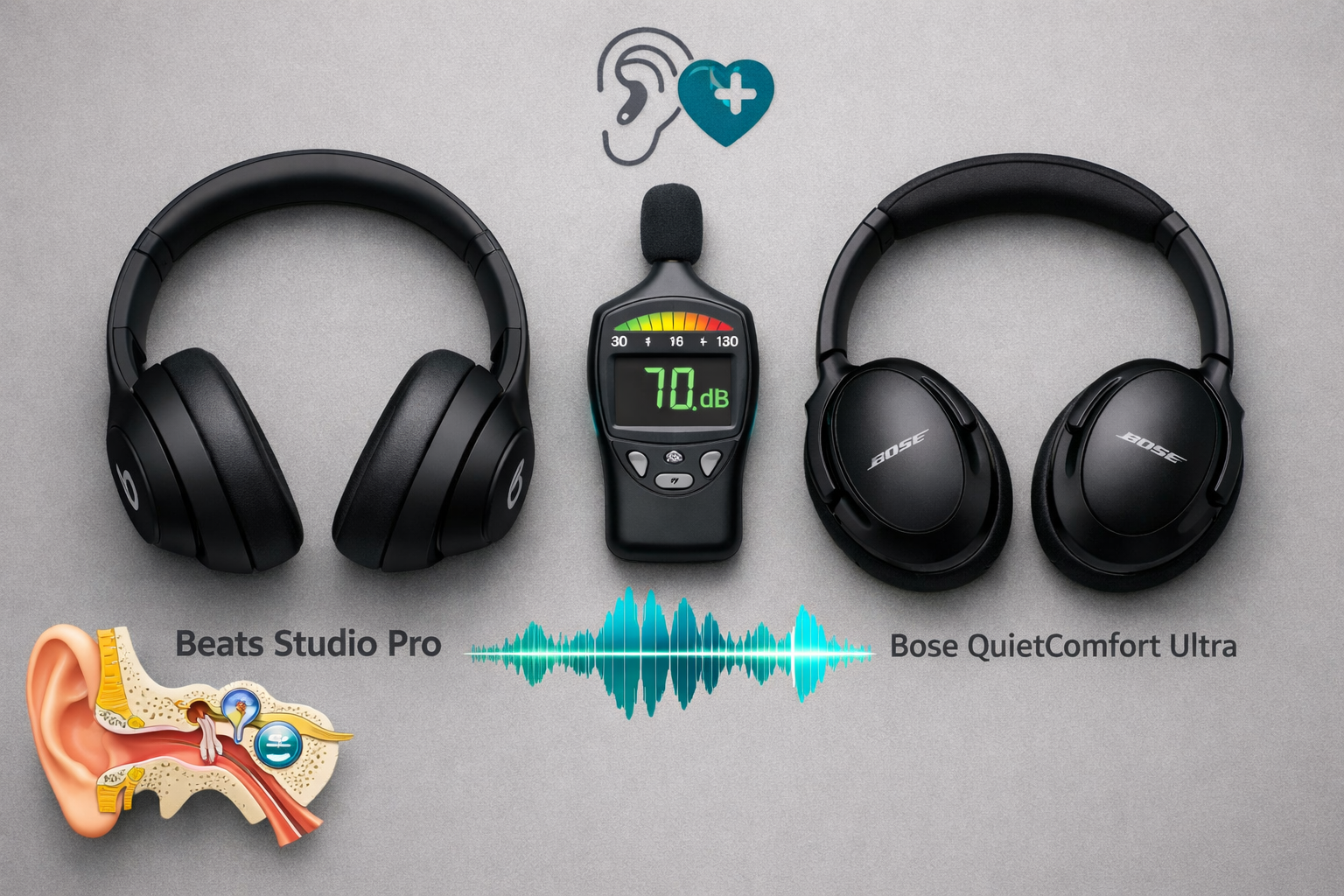
The Beats Studio Pro and Bose QuietComfort Ultra are both premium over-ear wireless headphones with active noise cancellation, but they’re built around different priorities. Beats focuses on a punchy, bass-heavy sound and long battery life; Bose focuses on comfort, balanced audio, and best-in-class noise cancellation.
Here’s a quick side-by-side:
| Feature | Beats Studio Pro | Bose QuietComfort Ultra |
|---|---|---|
| ANC Quality | Good | Excellent (class-leading) |
| Sound Profile | Bass-forward | Balanced/neutral |
| Weight | ~260g | ~253g |
| Battery Life (ANC on) | Up to 40 hours | Up to 24 hours |
| Clamping Force | Higher | Gentler |
| Ear Cushion Breathability | Standard foam | Perforated edges |
| App EQ | Yes (Beats app) | Yes (3-band EQ) |
| Price (approx. 2026) | ~$299 | ~$349 |
Sources: [1][3][4]
Which Headphones Have Better Noise Cancellation for Hearing Protection?
The Bose QuietComfort Ultra wins on noise cancellation. Independent testing shows the Bose QC Ultra reduces external noise more effectively across the full frequency range compared to the Beats Studio Pro. [1] This matters for hearing health because better ANC means you don’t need to raise the volume to hear over background noise.
Here’s why this is the key hearing-protection metric:
- The volume compensation problem: In noisy environments (subway, airplane, open office), people instinctively turn up their headphones to mask ambient sound. This is called the Lombard effect, and it’s a major driver of noise-induced hearing damage.
- Better ANC = lower listening volumes: When headphones block more external noise passively and actively, your ears receive the audio signal at a lower decibel level.
- Beats Studio Pro ANC is decent but doesn’t match Bose across all frequencies, especially in the low-to-mid range where traffic and HVAC noise live. [1]
Choose Bose QC Ultra if: You regularly use headphones in loud environments (commuting, open offices, travel) and want the best passive hearing protection.
For a deeper look at how noise cancellation stacks up against regular headphones for ear safety, see this guide on noise-cancelling vs regular headphones and hearing health.
Do Beats Studio Pro Protect Your Ears Better Than Bose? Sound Quality and Volume Risk
No, the Bose QuietComfort Ultra is the more hearing-friendly option, largely because of its sound signature. The Beats Studio Pro’s bass-forward tuning means that mid and high frequencies can feel recessed, which leads many listeners to push the volume higher to hear vocals and detail clearly. [3]
The Bose QC Ultra’s balanced profile lets you enjoy music at moderate volumes without losing clarity. That’s a meaningful difference over hours of daily use.
What this means in practice:
- A listener using Beats Studio Pro might set volume at 70-75% to get satisfying clarity.
- The same listener on Bose QC Ultra might be satisfied at 60-65%, a difference that adds up to significantly less cumulative noise exposure over weeks and months.
For more on how Beats-specific settings can be adjusted for safer listening, the guide on Beats headphones and hearing loss features covers the Beats app volume controls in detail.
Can Wearing Noise-Cancelling Headphones Damage Your Hearing?
Noise-cancelling headphones don’t inherently damage hearing, but they can if used at high volumes for extended periods. The risk isn’t the ANC technology itself; it’s the listening behavior the headphones enable.
The safe listening threshold: The World Health Organization (WHO) recommends keeping personal audio devices at or below 85 decibels (dB) for no more than 8 hours per day, with lower limits for higher volumes. Exposure to 100 dB, for example, should be limited to roughly 15 minutes.
Key points:
- Both the Beats Studio Pro and Bose QC Ultra are capable of producing volumes well above safe limits.
- Neither headphone automatically enforces a volume cap for adults (though iOS and Android both offer optional volume warnings).
- The Bose QC Ultra’s stronger ANC reduces the temptation to exceed safe volumes in noisy settings. [1]
If you’re concerned about cumulative hearing damage, the article on understanding hearing damage, causes, and prevention is worth reading alongside this comparison.
What’s the Maximum Safe Decibel Level, and Do These Headphones Have Volume Limits?
The standard safe listening guideline is 85 dB for up to 8 hours. Above that, safe exposure time drops sharply, every 3 dB increase roughly halves the recommended exposure time.
Neither the Beats Studio Pro nor the Bose QuietComfort Ultra ships with a hard volume cap for adults in 2026. However:
- iOS users can set a headphone safety limit in Settings > Sounds & Haptics > Headphone Safety.
- Android users can enable volume warnings in Accessibility settings.
- The Bose Music app allows EQ customization that can reduce the need for high volumes. [3]
- The Beats app offers similar EQ tools, but the default bass boost profile still encourages higher volume use.
Practical tip: Set your phone’s volume limit to 60-70% as a default. If you can’t hear clearly at that level in a quiet room, your headphones’ ANC may not be strong enough for your environment, which is an argument for upgrading the ANC rather than raising the volume.
Which Headphones Are Better for Long Listening Sessions Without Ear Fatigue?
The Bose QuietComfort Ultra is better for extended wear. It’s lighter, uses softer ear cushions with perforated edges for airflow, and applies less clamping force than the Beats Studio Pro. [2]
Why clamping force matters for ear health:
- High clamping force compresses the outer ear and surrounding tissue, reducing blood flow and causing soreness over time.
- The Beats Studio Pro’s tighter grip is noticeable after 1-2 hours for many users.
- Bose’s gradual-compression padding distributes weight more evenly and adapts to head shape. [2]
Why breathability matters:
- Heat and moisture buildup inside ear cups can cause skin irritation and discomfort.
- The Bose QC Ultra’s perforated ear cushion edges allow better airflow, reducing this problem during long sessions. [2]
Choose Beats Studio Pro if: You need maximum battery life (40 hours vs. 24 hours [4]) and plan to use headphones across multiple days without charging. The longer ANC runtime means consistent noise reduction between charges.
For people exploring headphone options specifically for hearing loss or sensitivity, the best headphones for hearing loss guide covers a wider range of options.
Are Beats Studio Pro or Bose Better for People With Sensitive Ears?
For people with sensitive ears, tinnitus, or a history of hearing issues, the Bose QuietComfort Ultra is the safer and more comfortable choice. Its gentler clamping force, balanced sound profile, and superior ANC all reduce the conditions that aggravate sensitive hearing.
Specific considerations for sensitive ears:
- Tinnitus sufferers benefit from lower listening volumes, the Bose QC Ultra’s ANC and neutral tuning support this better. If tinnitus is a concern, the complete guide to tinnitus explains how sound exposure affects symptoms.
- People with ear canal sensitivity may find the over-ear design of both headphones preferable to in-ear options, since neither model sits inside the ear canal.
- Those with jaw or TMJ issues should note that the Beats Studio Pro’s higher clamping force can increase pressure around the jaw area during long sessions.
Which Headphones Are Better for Commuting and Hearing Protection?
For commuting, the Bose QuietComfort Ultra is the better choice for hearing protection. Commute environments (subway, bus, train) produce consistent low-frequency noise in the 70-85 dB range, exactly where Bose’s ANC performs best. [1]
Commuting-specific factors:
- Stronger ANC means lower listening volumes in transit noise.
- The Bose QC Ultra’s lighter weight and softer cushions are more comfortable for the 30-90 minute commute window.
- The Beats Studio Pro’s 40-hour battery is an advantage for multi-day travel, but for daily commuting, 24 hours is sufficient for most users.
Common mistake: Many commuters use in-ear earbuds on public transit and compensate for poor noise isolation by maxing out volume. Switching to either of these over-ear headphones with ANC is a significant hearing health upgrade, but the Bose QC Ultra takes it further.
Do Either of These Headphones Have Hearing Health Monitoring?
As of 2026, neither the Beats Studio Pro nor the Bose QuietComfort Ultra includes dedicated hearing health monitoring hardware. Neither headphone tracks cumulative noise dose, measures ambient decibel levels in real time, or sends hearing health alerts natively.
What they do offer:
- Both work with iOS and Android volume safety features.
- The Bose Music app includes an EQ that can be used to reduce reliance on high volumes. [3]
- Apple’s Health app tracks headphone audio levels when using Beats (an Apple-owned brand) with an iPhone.
For a comparison of headphones that go further on hearing health features, the AirPods Max vs noise-cancelling headphones comparison covers Apple’s more advanced hearing health integration.
What Should You Know About Prolonged Headphone Use and Ear Safety?
Prolonged headphone use, regardless of brand, carries real hearing risks if volume and duration aren’t managed. The key risk is noise-induced hearing loss (NIHL), which is permanent and cumulative.
Practical rules for safe headphone use:
- Follow the 60/60 rule: Listen at no more than 60% volume for no more than 60 minutes at a stretch.
- Take listening breaks: Give your ears 10-15 minutes of quiet after every hour of use.
- Use ANC actively: Turn on noise cancellation so you don’t compensate with volume.
- Check your volume in quiet rooms: If you need high volume in a quiet space, something is wrong, either the headphones fit poorly or your hearing may already be affected.
- Monitor for warning signs: Ringing in the ears after listening sessions is an early sign of overexposure. See the guide on tinnitus and hearing health for more detail.
The hearing loss and cognitive decline research also makes a compelling case for why protecting your hearing now matters far beyond just sound quality.
FAQ
Q: Which is louder, Beats Studio Pro or Bose QuietComfort Ultra? Both headphones can reach volumes well above safe listening levels. The Beats Studio Pro’s bass boost can make it feel louder at the same volume setting, but both are capable of exceeding 100 dB at maximum output.
Q: Does the Bose QuietComfort Ultra have better ear protection than Beats Studio Pro? Yes, in practical terms. Its superior ANC reduces the need for high volumes, its balanced sound profile supports moderate listening levels, and its comfortable fit reduces ear fatigue. [1][2]
Q: How much do Beats Studio Pro cost vs Bose QuietComfort Ultra? In 2026, the Beats Studio Pro retails for approximately $299, while the Bose QuietComfort Ultra is approximately $349. Prices vary by retailer and region. [4]
Q: Can I use either headphone to protect my ears from loud environments? These are consumer headphones, not hearing protection devices. They reduce ambient noise through ANC and passive isolation, but they don’t meet industrial hearing protection standards (like NRR-rated earmuffs). For workplace noise hazards, use certified hearing protection.
Q: Which headphone is better for people with tinnitus? The Bose QuietComfort Ultra is generally better for tinnitus sufferers because its stronger ANC and balanced sound profile support lower listening volumes, reducing further noise exposure.
Q: Does Beats Studio Pro have a volume limit feature? Not a hardware cap, but the Beats app and iOS Headphone Safety settings allow users to set a maximum volume limit on iPhone and iPad.
Q: Is 40 hours of battery life on Beats Studio Pro better for hearing health? Longer battery life means the ANC stays active longer between charges, which is a minor hearing health advantage. But it also means more potential listening time, which requires more discipline around volume and duration.
Q: Which headphone is better for office use? The Bose QuietComfort Ultra is better for office environments. Its ANC handles HVAC and open-plan office noise more effectively, letting you work at lower volumes.
Q: Do either headphone work well for people with glasses? The Bose QC Ultra’s softer cushions generally create a better seal around glasses frames, reducing sound leakage and maintaining ANC effectiveness. The Beats Studio Pro’s tighter clamp can press glasses arms into the head uncomfortably over time.
Q: Are there better alternatives for hearing-focused headphone users? Yes. Sony WH-1000XM5 and Apple AirPods Max both offer strong ANC and hearing health integration. The wireless speakers, earbuds, and headphones buyer’s guide covers a broader set of options.
Conclusion
When the question is Beats Studio Pro vs Bose QuietComfort Ultra: which headphones better protect your ears, the answer is clear: the Bose QuietComfort Ultra is the more hearing-friendly choice. Its class-leading ANC reduces the need to raise volume in noisy environments, its balanced sound profile doesn’t push you toward higher volume for clarity, and its lighter, softer design reduces ear fatigue during long sessions. [1][2][3]
The Beats Studio Pro isn’t a bad headphone, its 40-hour battery life is a genuine advantage, and its sound quality is excellent for music lovers who enjoy bass-heavy genres. But for anyone prioritizing ear health, the Bose QC Ultra’s design philosophy aligns more closely with safe listening habits.
Actionable next steps:
- If you already own either headphone, enable your phone’s Headphone Safety volume limit today.
- Turn on ANC every time you use headphones in a noisy environment, don’t save it for “special occasions.”
- Take a 10-minute break from headphones every hour, especially during work-from-home sessions.
- If you notice ringing in your ears after listening sessions, reduce your volume by 10-15% and consult an audiologist.
Your hearing is irreplaceable. The right headphone choice, and the right habits, make a real difference.
References
[2] Beats Studio Pro Vs Bose Quietcomfort Ultra Comfort Comparison – https://www.alibaba.com/product-insights/beats-studio-pro-vs-bose-quietcomfort-ultra-comfort-comparison.html?utm_source=openai
[3] Beats Studio Pro Vs Bose Quietcomfort – https://www.eneba.com/hub/gaming-gear/beats-studio-pro-vs-bose-quietcomfort/?utm_source=openai
[4] Beats Studio Pro Vs Bose Quietcomfort Ultra – https://hometosight.com/beats-studio-pro-vs-bose-quietcomfort-ultra/?utm_source=openai
