Last updated: July 6, 2026
Quick Answer: The AirPods Max and competing noise-cancelling headphones like the Sony WH-1000XM5 are both consumer audio devices, not certified hearing protectors. Neither carries a Noise Reduction Rating (NRR). That said, strong active noise cancellation (ANC) can help you listen at lower volumes, which does reduce hearing risk. The safest choice depends less on the brand and more on how you use it: volume level, daily wear time, and whether you use built-in safe-listening features.
Key Takeaways
- 🎧 Neither AirPods Max nor other ANC headphones are certified hearing protection devices (no NRR rating).
- 📉 Strong ANC reduces background noise, which lets you turn the volume down, that’s the real hearing safety benefit.
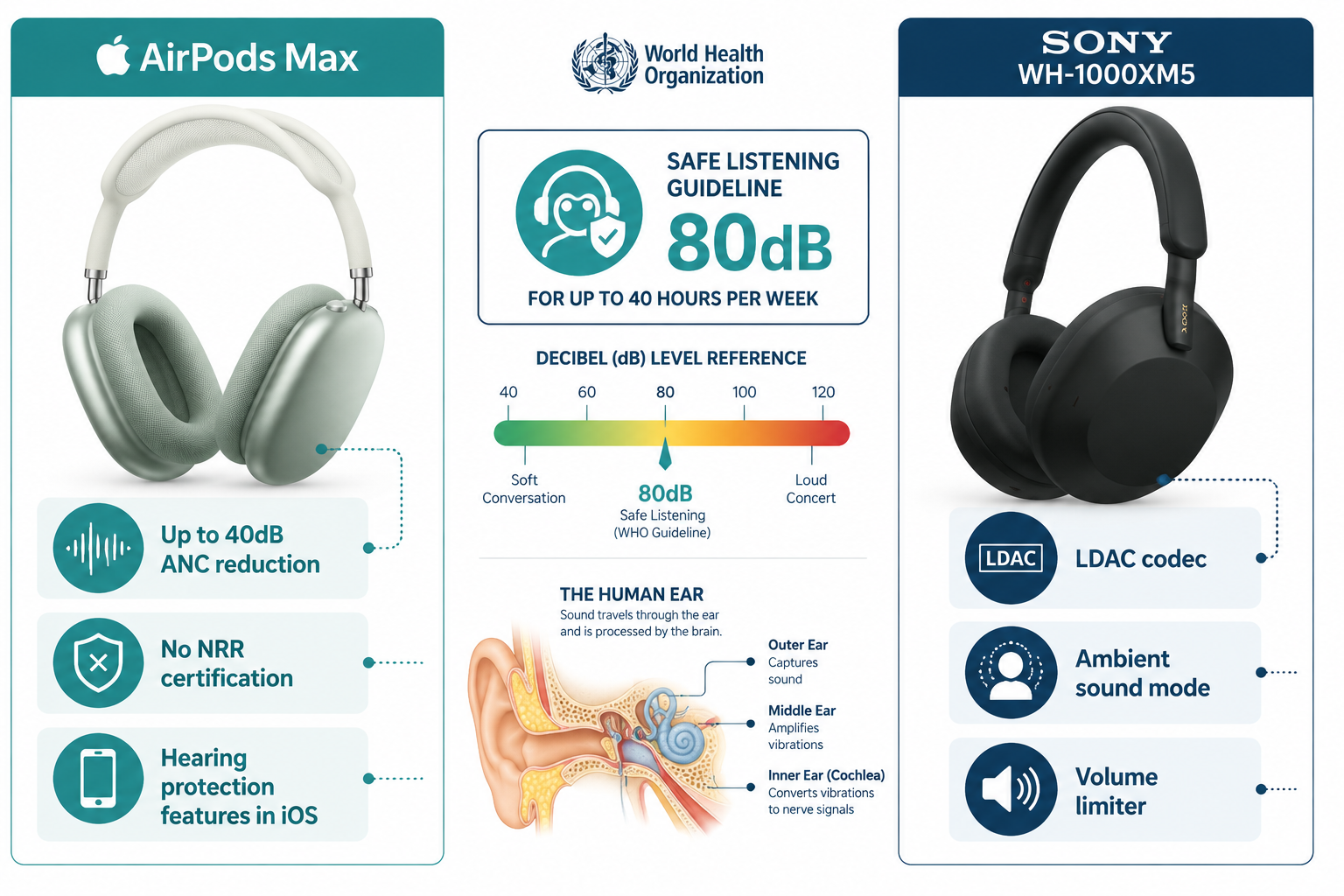
- 🔊 The WHO recommends keeping listening levels at or below 80 dB for up to 40 hours per week [3].
- ⏱️ The “60/60 rule”, 60% max volume, 60-minute sessions, is a widely recommended safe-listening guideline [3].
- 🍎 AirPods Max (via iOS) includes Headphone Notifications and Reduce Loud Sounds settings that actively cap volume.
- 🏆 The AirPods Max reduces low-frequency noise by up to 40 dB in ANC tests, which is among the best in class [5].
- 👂 Over-ear headphones are generally safer than earbuds because they sit farther from the eardrum.
- ⚠️ ANC headphones should never replace certified hearing protection in industrial or high-noise work environments [1].
- 🔕 Noise-cancelling headphones can help reduce listening fatigue and anxiety from constant ambient noise, a secondary hearing health benefit.
What’s the Difference Between AirPods Max and Regular Noise-Cancelling Headphones?
The AirPods Max is Apple’s premium over-ear headphone with deep iOS integration, while “regular” noise-cancelling headphones (Sony WH-1000XM5, Bose QuietComfort Ultra, etc.) are standalone devices that work across platforms. Both use active noise cancellation (ANC), but they differ in ecosystem features, fit, and safe-listening tools.
Here’s a quick side-by-side:
| Feature | AirPods Max | Sony WH-1000XM5 | Bose QC Ultra |
|---|---|---|---|
| ANC strength (low-freq) | Up to ~40 dB [5] | Strong (comparable) | Strong |
| NRR certification | None [4] | None | None |
| Volume limiter (built-in) | Yes (iOS settings) | App-based | App-based |
| Headphone notifications | Yes (iOS Health) | No native equivalent | No native equivalent |
| Over-ear fit (seal quality) | Excellent (mesh canopy) | Very good | Very good |
| Transparency/ambient mode | Yes | Yes | Yes |
Key distinction for hearing health: The AirPods Max has tighter integration with Apple Health’s hearing features. If you’re an iPhone user, this gives you real-time alerts when volume is too high, something Sony and Bose don’t offer natively.
Are AirPods Max Safe for Hearing Health Long Term?
Yes, with responsible use. The AirPods Max can reach high output levels like any consumer headphone, so long-term safety depends entirely on how loud and how long you listen. The good news is that Apple’s iOS ecosystem includes tools that actively monitor and limit exposure.
What helps with the AirPods Max specifically:
- Reduce Loud Sounds setting in iPhone Settings > Sounds & Haptics caps output at a chosen dB level (75, 80, 85, or 100 dB).
- Headphone Notifications in the Health app alert you when your 7-day average exceeds WHO-recommended thresholds.
- Strong ANC means less need to crank the volume in noisy environments.
What to watch for:
- Listening at high volumes for extended sessions still causes damage, even with ANC active.
- The AirPods Max has no NRR and is not a hearing protector [4].
For a broader look at how wireless audio devices affect hearing, see this guide on AirPods and hearing health.
How Do Noise-Cancelling Headphones Affect Hearing Compared to Regular Headphones?
ANC headphones can actually be better for hearing health than regular headphones, but only if you use the ANC feature properly. The core benefit: by reducing ambient noise, ANC lets you hear your audio clearly at a lower volume, reducing overall sound exposure to your ears.
Regular (passive) headphones offer no noise reduction unless they have a physical seal. In loud environments, people tend to turn up the volume to compete with background noise, that’s where the real hearing damage happens.
“The primary hearing benefit of ANC headphones is that they reduce the temptation to raise volume in noisy environments.”, Audiologist consensus, cited in [7]
However, ANC headphones are less effective against sudden, high-frequency sounds [2]. A loud bang or sharp noise can still reach your ears at full intensity. And in genuinely hazardous noise environments (construction sites, loud machinery), ANC headphones are not a substitute for certified ear protection [1].
What’s the Safest Volume Level for Over-Ear Headphones?
Keep listening levels at or below 80 dB for up to 40 hours per week, according to the World Health Organization [3]. Most smartphones display volume as a percentage, 60% on most devices roughly corresponds to a safe listening level in quiet environments.
Practical rules:
- 60/60 rule: No more than 60% of max volume for no more than 60 minutes at a stretch [3].
- Conversation test: If someone next to you can’t hear your headphones, you’re likely in a safe range.
- Quiet environment bonus: In a quiet room, 50-60% volume on most devices stays well under 80 dB.
Personal audio devices can reach 100 dB or more at full volume [3]. At 100 dB, hearing damage can begin within minutes of exposure. This applies equally to AirPods Max, Sony, Bose, and every other consumer headphone.
Understanding hearing damage causes, prevention, and solutions can help you build better habits before problems start.
Can Noise-Cancelling Headphones Damage Your Ears or Hearing?
No, ANC technology itself does not damage hearing. The ANC mechanism works by generating an inverse sound wave that cancels ambient noise electronically. Some people feel a slight pressure sensation when ANC is active, but this is not harmful to the ear [7].
What does cause damage:
- Listening at high volumes for extended periods (noise-induced hearing loss, or NIHL).
- Using headphones in loud environments without lowering the volume.
- Ignoring volume warnings or alerts.
According to Mayo Clinic Health System, approximately 24% of individuals aged 12-35 listen at unsafe levels [6]. The headphone type matters less than the listening behavior.
Common mistake: Assuming that because ANC blocks outside noise, you can safely listen at higher volumes. You can’t, the damage comes from the audio going into your ears, not from outside noise.
AirPods Max vs Sony WH-1000XM5: Which Is Better for Ear Health?
For hearing safety specifically, the AirPods Max has an edge for iPhone users because of its native iOS health integration. The Sony WH-1000XM5 is excellent on ANC performance but lacks built-in volume health monitoring.
Choose AirPods Max if:
- You use an iPhone and want automatic volume alerts and caps.
- You want the tightest ANC performance for low-frequency noise reduction (up to ~40 dB) [5].
- You want Transparency Mode for situational awareness without removing headphones.
Choose Sony WH-1000XM5 if:
- You use Android or a multi-platform setup.
- You prefer a lighter headphone for long wear sessions.
- You want LDAC high-res audio codec support.
Both are consumer devices with no NRR. Neither is safer than the other in absolute terms, the difference is in the ecosystem tools that help you stay within safe limits.
For a deeper look at another popular option, see Beats headphones and hearing loss features.
How Long Can You Safely Wear Noise-Cancelling Headphones Per Day?
Most audiologists suggest no more than 1-2 hours of continuous use before taking a break, with total daily use kept to a level that keeps your weekly average below 80 dB [3]. There’s no single “safe hours per day” number because it depends on volume level.
A simple framework:
| Volume Level | Max Continuous Duration |
|---|---|
| 60% (approx. 70-75 dB) | 2-4 hours comfortably |
| 75% (approx. 80-85 dB) | 1-2 hours |
| 85%+ (approx. 90+ dB) | Under 30 minutes |
| 100% (100+ dB) | Minutes only |
Physical comfort matters too. Over-ear headphones create clamping pressure on the ears and jaw. Extended wear (4+ hours) can cause ear fatigue, soreness, and in some cases aggravate jaw tension, separate from hearing damage but still worth managing.
Do AirPods Max Have Hearing Protection Features?
Yes, the AirPods Max has several hearing-related features built into iOS, making it one of the more hearing-health-conscious consumer headphones available in 2026.
Key features:
- Reduce Loud Sounds: Found in Settings > Sounds & Haptics > Headphone Safety. Caps maximum output at 75, 80, 85, or 100 dB.
- Headphone Notifications: Sends alerts via Apple Health when your 7-day average audio exposure exceeds safe levels.
- Headphone Audio Levels: Tracked in the Health app, showing your exposure history over time.
Important caveat: These features are safety aids, not hearing protection. The AirPods Max is not classified as a hearing protection device and carries no NRR [4]. OSHA confirms that consumer ANC headphones are not certified for occupational hearing protection [1].
If you’re looking for headphones specifically designed around hearing loss, see best headphones for hearing loss.
Are Over-Ear Headphones Safer Than Earbuds for Hearing?
Generally, yes. Over-ear headphones sit around the ear rather than inside the ear canal, which means the speaker driver is farther from the eardrum. This distance reduces the intensity of sound reaching the inner ear at any given volume setting.
In-ear earbuds (including AirPods Pro) place the driver directly in the ear canal, which can deliver sound at higher effective intensities even at the same volume percentage. For a direct comparison, see AirPods Pro 3 and hearing health.
Over-ear advantages for hearing safety:
- Greater driver-to-eardrum distance.
- Better passive isolation from physical seal (reduces need to raise volume).
- Less occlusion effect (the blocked feeling that makes people raise volume with in-ear models).
Over-ear disadvantages:
- More clamping pressure over long sessions.
- Can trap heat, which some users find uncomfortable.
What Causes Hearing Damage From Headphones and How to Prevent It
Hearing damage from headphones is caused by noise-induced hearing loss (NIHL), the destruction of tiny hair cells in the cochlea that don’t regenerate. Loud sounds cause these cells to vibrate so intensely they break down over time.
Main risk factors:
- High volume (above 85 dB).
- Long duration without breaks.
- Repeated daily exposure over months and years.
- Listening in noisy environments and compensating by raising volume.
Prevention steps:
- Use the volume limiter on your device or in your headphone app.
- Enable headphone notifications (AirPods Max users: turn this on in iOS Health).
- Follow the 60/60 rule as a baseline habit.
- Use ANC in noisy environments instead of raising volume.
- Take 10-15 minute breaks every hour.
- Get a hearing check annually if you’re a heavy headphone user.
The NIDCD recommends avoiding loud sounds, moving away from noise sources, and using certified hearing protectors when those options aren’t available [8]. Headphones, even the best ANC models, are not a substitute for certified protection in genuinely hazardous environments.
Untreated hearing loss carries serious long-term risks. Research links it to cognitive decline, for more on that connection, see hearing loss and cognitive decline.
Best Noise-Cancelling Headphones for People With Sensitive Hearing
People with sensitive hearing, tinnitus, or existing hearing loss should prioritize headphones with strong ANC (to reduce the need for high volume), built-in volume limiting, and a comfortable over-ear fit that doesn’t create excessive pressure.
Top picks for sensitive hearing in 2026:
- AirPods Max (Apple ecosystem): Best for iPhone users who want native health monitoring and volume caps. Strong ANC, excellent transparency mode.
- Sony WH-1000XM5: Excellent ANC, lightweight, good for long wear. Use the Sony Headphones Connect app to set volume limits.
- Bose QuietComfort Ultra: Known for comfort over long sessions; good for those with ear fatigue issues.
What to avoid:
- In-ear earbuds at high volumes (higher effective SPL at the eardrum).
- Headphones without any volume-limiting option.
- Using any headphone without ANC in loud environments.
If you experience ringing in your ears after listening sessions, that’s a warning sign. Learn more about tinnitus and what it means for your hearing.
Hearing Damage From Headphones: How to Know If You’re at Risk
You may be at risk if you regularly listen at high volumes, use headphones for several hours daily, or notice any of the following warning signs:
Early warning signs of NIHL:
- Ringing or buzzing in the ears after listening (temporary tinnitus).
- Sounds seeming muffled after a session.
- Needing to ask people to repeat themselves more often.
- Difficulty following conversations in noisy places.
Who is at higher risk:
- Teenagers and young adults (24% listen at unsafe levels, per Mayo Clinic data [6]).
- People who commute in loud environments (trains, subways) and raise volume to compensate.
- Musicians or frequent concert-goers who also use headphones heavily.
What to do: If you notice any warning signs, reduce volume immediately and book a hearing test. Early-stage noise-induced hearing loss can stabilize if the cause is removed promptly.
Conclusion: Which Over-Ear Option Is Safest for Your Hearing?
When comparing AirPods Max vs noise-cancelling headphones for hearing safety, the honest answer is that no consumer headphone is inherently “safe”, safety comes from how you use it. That said, the AirPods Max holds a practical advantage for iPhone users thanks to its native iOS health features, including real-time volume alerts and a built-in loudness cap.
For Android users or those who want a lighter, more versatile option, the Sony WH-1000XM5 or Bose QuietComfort Ultra are strong alternatives, just configure volume limits through their companion apps.
Actionable next steps:
- Turn on Headphone Safety settings right now if you use AirPods Max (Settings > Sounds & Haptics > Headphone Safety).
- Set a volume cap at 80 dB or below on any device you use.
- Start the 60/60 habit this week, 60% volume, 60-minute sessions.
- Use ANC actively in noisy environments instead of raising volume.
- Book a baseline hearing test if you’ve been a heavy headphone user for years.
Your hearing is one of the few things that doesn’t repair itself once damaged. Choosing the right headphone is step one, using it wisely is the part that actually protects you.
Frequently Asked Questions
Q: Do AirPods Max have a Noise Reduction Rating (NRR)? No. The AirPods Max has no NRR because it is a consumer audio device, not a certified hearing protector. NRR ratings apply only to devices designed and tested for occupational hearing protection [4].
Q: Can the ANC in AirPods Max actually prevent hearing damage? Indirectly, yes. By reducing ambient noise by up to ~40 dB [5], ANC lets you listen at lower volumes, which reduces your total sound exposure. But ANC itself doesn’t protect against damage from the audio you’re playing.
Q: Is it safe to sleep with noise-cancelling headphones on? Not recommended. Extended pressure on the ears and the risk of unintentionally high volume during sleep make this a poor habit. Over-ear headphones also create physical pressure that can cause discomfort or ear pain overnight.
Q: Does ANC cause a pressure sensation in the ears? Some people notice a mild pressure feeling when ANC is active. This is not harmful, it’s a perceptual effect from the anti-noise wave, not physical pressure on the eardrum [7].
Q: Which is safer for kids: AirPods Max or other noise-cancelling headphones? For children, volume-limiting headphones designed for kids (capped at 85 dB or lower) are the safest choice. The AirPods Max can be configured with parental volume limits via iOS Screen Time, which makes it a reasonable option for older children if properly set up.
Q: How often should heavy headphone users get a hearing test? Annually is a reasonable baseline for anyone who uses headphones more than 2 hours daily. If you notice any symptoms (ringing, muffled sounds), see an audiologist sooner.
Q: Are noise-cancelling headphones safe for people who already have tinnitus? Yes, with care. ANC can actually help tinnitus sufferers by reducing the need to raise volume in noisy environments. Avoid using headphones at high volumes, and use transparency mode when situational awareness is needed.
Q: Does the Sony WH-1000XM5 have volume health monitoring like the AirPods Max? Not natively. The Sony Headphones Connect app lets you set a volume limit, but it doesn’t track cumulative exposure or send health alerts the way Apple’s Health app does with AirPods Max.
References
[1] OSHA Standard Interpretation on Noise-Canceling Headphones – https://www.osha.gov/laws-regs/standardinterpretations/2023-03-06
[2] Noise Cancelling Headphones Hearing Protection – https://hearinginsider.com/noise-cancelling-headphones-hearing-protection
[3] Safe Headphone Volume – https://instituteofdoctors.com/fr/guides/safe-headphone-volume
[4] Noise Canceling Headphones And Hearing Loss – https://www.audibel.com/preventative-care/noise-canceling-headphones-and-hearing-loss/
[5] Sony WH-1000XM6 vs AirPods Max – https://www.soundguys.com/sony-wh-1000xm6-vs-airpods-max-137863/
[6] Earbuds And Hearing Loss – https://www.mayoclinichealthsystem.org/hometown-health/speaking-of-health/earbuds-and-hearing-loss
[7] Noise Canceling Headphones Harmful – https://www.soundly.com/blog/noise-canceling-headphones-harmful
[8] NIDCD Hearing Protectors – https://www.nidcd.nih.gov/health/hearing-protectors
