
Last updated: June 24, 2026
Quick Answer: New research linking age-related hearing loss to increased dementia risk confirms that adults with untreated hearing loss face significantly higher odds of developing dementia — with some studies showing risk increases of up to 59% compared to those with normal hearing. The good news: addressing hearing loss early, including using hearing aids, may help reduce that risk.
Key Takeaways
- Every 10-decibel drop in hearing is associated with a 16–27% increase in dementia risk, according to multiple large studies [1][3].
- Adults with moderate to severe hearing impairment are roughly 1.55 times more likely to develop dementia than those with normal hearing [2].
- A meta-analysis of 14 cohorts covering over 726,900 participants found hearing loss independently linked to a 59% higher dementia risk [4].
- The connection likely involves cognitive overload, social isolation, and changes in brain structure caused by reduced auditory input.
- Hearing loss is one of the largest modifiable risk factors for dementia identified to date.
- Hearing aids and other interventions may slow cognitive decline, though more long-term trials are still needed.
- Age-related hearing loss (presbycusis) affects roughly two-thirds of adults over 70, making this a widespread public health concern.
- Early screening, prompt treatment, and social engagement are the most actionable steps adults can take right now.
What Is Age-Related Hearing Loss and Why Does It Matter for Brain Health?
Age-related hearing loss, also called presbycusis, is the gradual decline in hearing that occurs as people get older. It’s extremely common — and often goes untreated for years because the changes happen slowly.
What makes this especially important is that the ears and brain are deeply connected. When the auditory system stops sending clear signals, the brain has to work harder to fill in the gaps. Over time, that extra strain may contribute to cognitive decline.
For a thorough overview of how presbycusis develops and what it feels like, see this comprehensive guide to hearing loss associated with old age.
What Does New Research Linking Age-Related Hearing Loss to Increased Dementia Risk Actually Show?
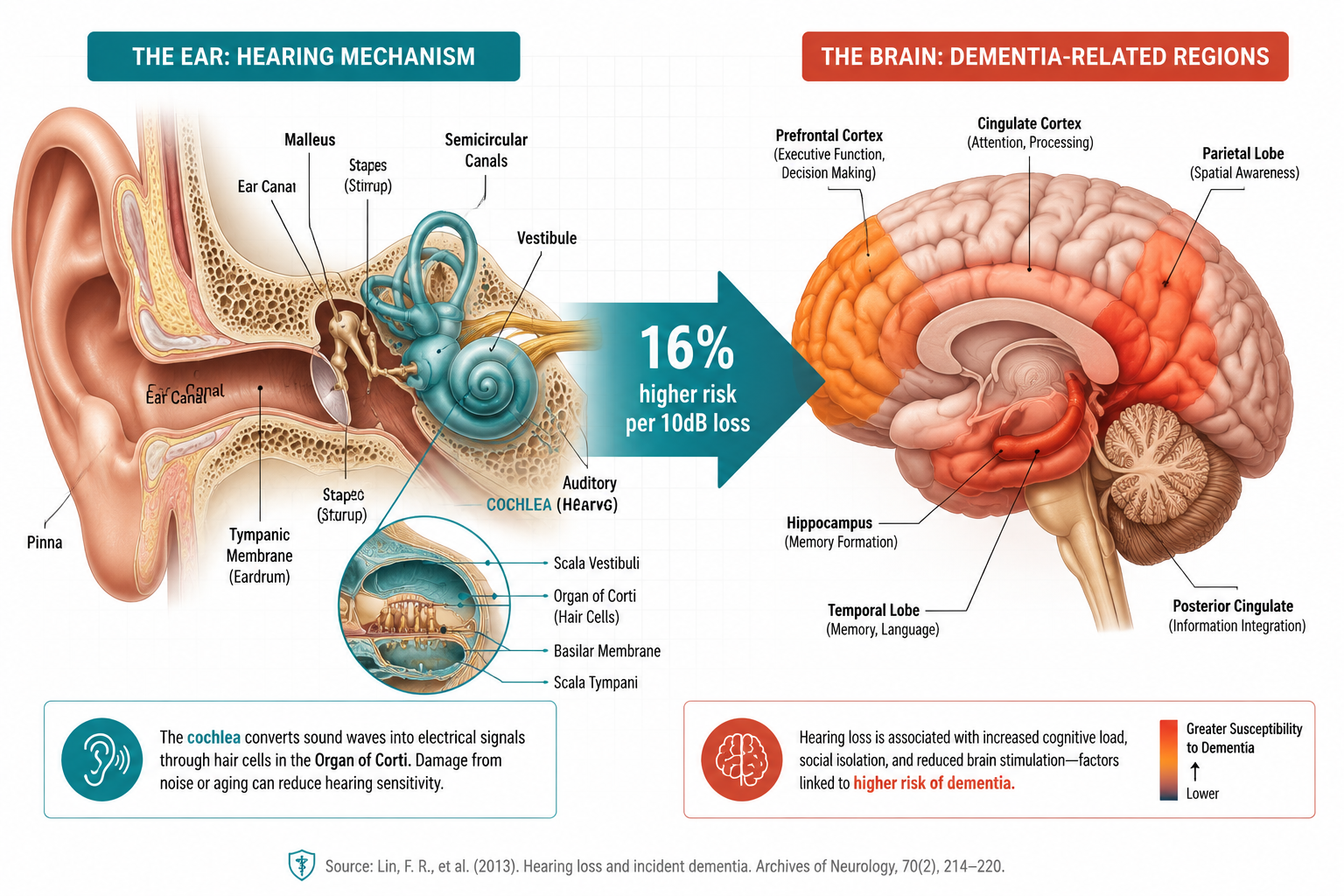
The evidence has been building for over a decade, and it’s now hard to ignore. New research linking age-related hearing loss to increased dementia risk consistently shows a dose-response relationship — meaning the worse the hearing loss, the higher the dementia risk.
Here’s a summary of the key findings:
| Study | Key Finding |
|---|---|
| Systematic Review & Meta-Analysis (2024) [1] | 16% higher dementia risk per 10 dB hearing loss |
| Baltimore Longitudinal Study of Aging (2011) [3] | 27% increased dementia risk per 10 dB loss |
| Health ABC Study (2016) [2] | 1.55x higher risk with moderate-severe hearing loss |
| Meta-Analysis of 726,900 participants (2021) [4] | 59% higher dementia risk with hearing loss |
| Systematic Review (2018) [5] | 2.39x greater risk of developing dementia |
| Population-Based Study, 4,463 adults 65+ (2014) [6] | 1.27x higher dementia risk vs. normal hearing |
These aren’t small or obscure studies. The 2021 meta-analysis alone covered nearly three-quarters of a million participants across 14 separate cohorts [4]. The consistency across different populations, countries, and study designs is what makes this evidence so compelling.
A 2023 analysis from the UK Brains for Dementia Research Cohort also found potential links between age-related hearing loss and the actual neuropathological changes seen in dementia brains — suggesting the connection may go deeper than behavior alone [7].
Why Does Hearing Loss Raise Dementia Risk? The Leading Theories
Researchers have proposed several mechanisms, and it’s likely that more than one is at work simultaneously.
1. Cognitive overload When hearing is impaired, the brain redirects resources normally used for memory and thinking toward decoding sound. This “cognitive load” hypothesis suggests that the brain essentially exhausts itself trying to hear, leaving less capacity for other functions.
2. Reduced auditory stimulation Less sound input means less stimulation for the auditory cortex. Over time, this may lead to structural changes in the brain — a kind of “use it or lose it” effect on neural pathways.
3. Social isolation Hearing loss makes conversation difficult and frustrating. Many people gradually withdraw from social situations. Social isolation is itself an independent risk factor for dementia, so this creates a compounding effect.
4. Shared underlying pathology The UK Brains for Dementia Research Cohort analysis raised the possibility that some of the same biological processes driving dementia may also affect the auditory system [7]. In other words, hearing loss and dementia may share common roots, not just a causal chain.
Understanding hearing loss and cognitive decline in more depth can help clarify which of these pathways is most relevant for any individual.
Who Is Most at Risk?
Not everyone with hearing loss will develop dementia, but certain groups face compounding risks.
Higher-risk profiles include:
- Adults over 70 with untreated moderate-to-severe hearing loss
- People who are socially isolated or living alone
- Individuals with other dementia risk factors (cardiovascular disease, diabetes, low physical activity)
- Those who have avoided hearing aids for many years despite significant hearing decline
Lower-risk (but still worth monitoring):
- Adults with mild hearing loss who remain socially active
- People using hearing aids consistently and engaging in cognitively stimulating activities
Choose early screening if you’re over 60, have a family history of dementia, or notice you’re frequently asking people to repeat themselves. Don’t wait until hearing loss becomes severe — that’s when the risk accumulates most.
For context on recognizing hearing loss symptoms early, a complete symptom guide can help identify warning signs before significant damage occurs.
Can Hearing Aids or Treatment Actually Reduce Dementia Risk?
This is the most important practical question, and the answer is cautiously optimistic. Several observational studies suggest that hearing aid use is associated with slower cognitive decline, though large-scale randomized controlled trials are still catching up.
The ACHIEVE trial (published in 2023 in The Lancet) found that hearing intervention significantly slowed cognitive decline in adults at higher baseline risk for dementia. While not definitive proof for all adults, it’s the strongest clinical evidence yet that treating hearing loss has real brain health benefits.
Practical steps that may help:
- Get a hearing test — ideally annually after age 60.
- Use hearing aids consistently if prescribed. Sporadic use reduces the benefit.
- Stay socially engaged — conversation is cognitive exercise.
- Protect remaining hearing — avoid loud environments without protection.
- Address other risk factors — manage blood pressure, stay physically active, sleep well.
For those exploring hearing device options, resources on hearing aids available through Amazon and effective hearing health strategies for seniors can help narrow down choices.
Common Mistakes People Make When Hearing Loss Is Detected
Waiting too long to act. The average person waits 7–10 years between noticing hearing difficulty and seeking treatment. Given what new research linking age-related hearing loss to increased dementia risk shows, that delay may carry real cognitive consequences.
Dismissing mild loss as “not that bad.” Even mild hearing loss has been associated with elevated dementia risk in some studies. The dose-response relationship means earlier intervention is better.
Using hearing aids inconsistently. Wearing a hearing aid for a few hours a day doesn’t provide the same auditory stimulation as consistent use. Audiologists generally recommend full-day wear.
Ignoring social withdrawal. If hearing loss is causing someone to skip family dinners or avoid phone calls, that isolation compounds the brain health risk. Addressing the social dimension matters as much as the device.
FAQ
Q: Does hearing loss directly cause dementia? A: The research shows a strong association, not proven direct causation. Hearing loss is considered a significant modifiable risk factor, meaning treating it may reduce risk — but it doesn’t guarantee dementia prevention.
Q: At what age should hearing screening begin? A: Most guidelines recommend baseline hearing tests by age 50, with annual or biennial screening from age 60 onward, especially if risk factors are present.
Q: Does one-sided hearing loss carry the same dementia risk? A: The research has focused mainly on bilateral hearing loss. Unilateral loss may carry lower risk, but it still warrants monitoring. See more on causes of hearing loss in one ear.
Q: How much hearing loss is considered “significant” for dementia risk? A: Studies define moderate hearing loss as roughly 41–60 decibels. The Health ABC Study found that moderate-to-severe loss (above 40 dB) was associated with 1.55x higher dementia risk [2].
Q: Can young adults with hearing loss also face elevated dementia risk later? A: The research focuses on age-related (adult-onset) hearing loss in older adults. However, protecting hearing throughout life — avoiding noise damage — is a sensible long-term strategy.
Q: Are cochlear implants also protective against dementia? A: Early research is promising, with some studies showing cognitive improvements after cochlear implantation in eligible adults. Larger trials are ongoing.
Q: Is tinnitus also linked to dementia risk? A: Tinnitus often co-occurs with hearing loss, and some research suggests an association with cognitive changes, though the evidence is less robust than for hearing loss itself.
Q: What’s the single most important action someone can take today? A: Book a hearing test. It’s non-invasive, often covered by insurance, and gives a clear baseline. Acting on the results — whether that’s hearing aids, monitoring, or lifestyle changes — is where the real benefit lies.
Conclusion
The evidence is clear and growing: new research linking age-related hearing loss to increased dementia risk shows this is one of the most significant — and most preventable — contributors to cognitive decline in older adults. A 59% higher dementia risk across nearly three-quarters of a million participants [4] is not a number to dismiss.
Actionable next steps:
- ✅ Schedule a hearing evaluation if you’re over 60 or notice any hearing changes.
- ✅ If hearing loss is confirmed, discuss hearing aids with an audiologist promptly.
- ✅ Stay socially active — conversation and connection protect the brain.
- ✅ Protect your hearing now by limiting exposure to loud noise.
- ✅ Talk to a doctor about your overall dementia risk profile, including cardiovascular health and sleep quality.
Hearing health and brain health are not separate concerns. Taking care of one is, increasingly, taking care of the other.
References
[1] Systematic Review and Meta-Analysis (2024) – https://www.sciencedirect.com/science/article/pii/S1568163724001648
[2] Health ABC Study – https://pubmed.ncbi.nlm.nih.gov/27071780/
[3] Baltimore Longitudinal Study of Aging (2011) – https://pubmed.ncbi.nlm.nih.gov/21320988/
[4] Meta-Analysis of Prospective Cohort Studies (2021) – https://pubmed.ncbi.nlm.nih.gov/34305572/
[5] Systematic Review and Meta-Analysis (2018) – https://pmc.ncbi.nlm.nih.gov/articles/PMC5806170/
[6] Prospective Population-Based Study (2014) – https://pubmed.ncbi.nlm.nih.gov/24662628/
[7] UK Brains for Dementia Research Cohort Analysis (2023) – https://onlinelibrary.wiley.com/doi/abs/10.1111/bpa.13188
