
Last updated: June 29, 2026
Quick Answer: Vertigo and dizziness are not the same thing. Dizziness is a broad term for feeling faint, unsteady, or woozy, while vertigo is a specific type that creates a false spinning sensation, usually caused by inner ear problems. Because the inner ear controls both balance and hearing, balance disorders can directly cause hearing loss, tinnitus, and ear pressure — and some combinations of symptoms need urgent medical attention.
Key Takeaways
- Vertigo = spinning sensation; dizziness is a broader term covering faintness, unsteadiness, and lightheadedness [1]
- The inner ear handles both balance and hearing, so problems there often affect both systems simultaneously [4]
- Conditions like Menière’s disease can cause vertigo, hearing loss, and tinnitus at the same time [3]
- Ringing in the ears (tinnitus) during dizziness episodes is a signal to get a professional hearing evaluation
- BPPV (benign paroxysmal positional vertigo) is the most common cause of vertigo and is highly treatable
- Sudden vertigo with hearing loss in one ear is a red flag that needs same-day medical care
- Dehydration, low blood sugar, and anxiety cause dizziness but do NOT typically cause vertigo [2]
- An audiologist can assess both hearing and vestibular function; a neurologist is needed if a central cause is suspected
- Many vertigo cases resolve with targeted exercises (vestibular rehabilitation) rather than medication alone
- Balance disorders become more common with age but are not a normal part of aging [4]
What’s the Difference Between Vertigo and Dizziness?
Dizziness is an umbrella term. It describes any sensation of being off-balance, faint, or woozy — but it doesn’t specify a cause or mechanism. Vertigo is a subset of dizziness with one defining feature: a false sense that you or your surroundings are spinning or moving when nothing is actually moving [1].
Think of it this way:
| Symptom | Category | Typical Cause |
|---|---|---|
| Feeling faint or lightheaded | Dizziness | Dehydration, low blood pressure, anxiety |
| Feeling unsteady on your feet | Dizziness | Anemia, medication side effects, fatigue |
| Room spinning, even when still | Vertigo | Inner ear disorder (BPPV, Menière’s, labyrinthitis) |
| Spinning triggered by head movement | Vertigo | BPPV (displaced ear crystals) |
Common mistake: Many people use “vertigo” to mean any dizziness. That matters clinically because the two have different causes and different treatments. Telling a doctor “I feel dizzy” versus “the room spins when I roll over in bed” leads to very different diagnostic paths.
What’s the Difference Between Vertigo and Lightheadedness?
Lightheadedness is the feeling that you might faint — a pre-syncope sensation often linked to a sudden drop in blood pressure or blood flow to the brain. Vertigo, by contrast, rarely involves feeling like you’ll pass out; instead, it feels like the environment is rotating or tilting [6].
- Lightheadedness: Standing up too fast, skipping meals, hot weather, dehydration
- Vertigo: Rolling over in bed, looking up, inner ear fluid imbalance, nerve inflammation
If lightheadedness comes with chest pain, shortness of breath, or a rapid heartbeat, that’s a cardiovascular concern, not an ear problem.
Can Inner Ear Problems Cause Both Vertigo and Hearing Problems?
Yes — and this is one of the most important connections to understand. The inner ear contains two functional systems housed in the same fluid-filled structure: the cochlea (hearing) and the vestibular system (balance). When something disrupts the inner ear, both systems can be affected at the same time [4].
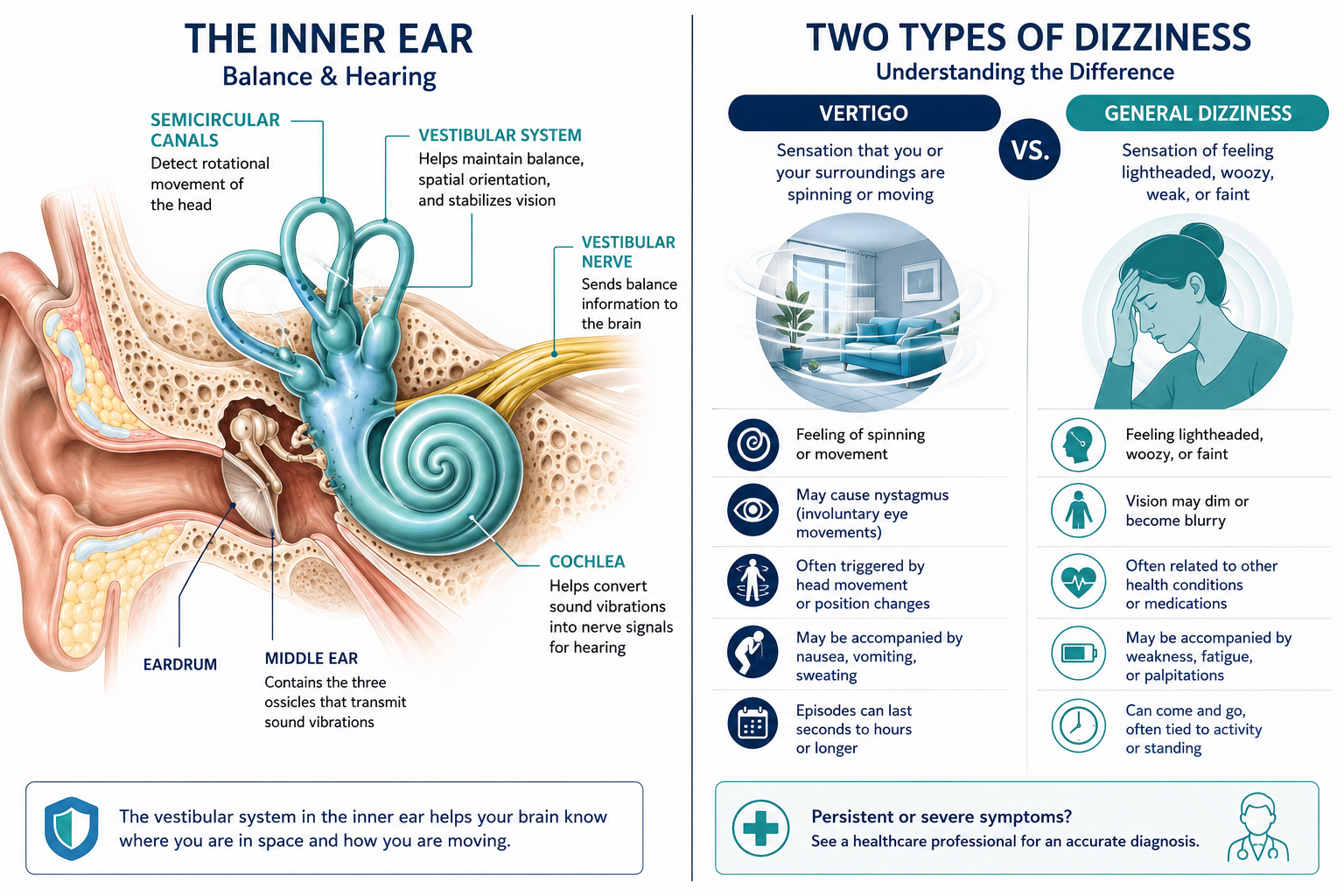
Conditions that commonly affect both:
- Menière’s disease: Causes episodes of severe vertigo, fluctuating hearing loss, ear fullness, and tinnitus — often in one ear. For a detailed breakdown, see our guide on Menière’s Disease: Symptoms, Hearing Loss Progression, and Treatment.
- Labyrinthitis: Inflammation of the inner ear labyrinth that can cause both vertigo and temporary hearing loss.
- Vestibular neuritis: Affects the balance nerve but usually spares hearing (unlike labyrinthitis).
- Acoustic neuroma: A benign tumor on the hearing/balance nerve that can cause one-sided hearing loss, tinnitus, and balance problems.
For a broader look at how ear conditions disrupt balance, the article on ear balance disorders covers the anatomy in plain language.
Why Does Dizziness Make My Ears Ring?
Tinnitus (ringing, buzzing, or hissing in the ears) during dizziness episodes usually signals inner ear involvement. The cochlea and vestibular system share fluid and nerve pathways, so when pressure or fluid balance is disrupted, both hearing and balance signals get scrambled [3].
The most common reason: endolymphatic hydrops, an abnormal buildup of inner ear fluid. This is the underlying mechanism in Menière’s disease. When fluid pressure spikes, it simultaneously distorts balance signals (causing vertigo) and sound processing (causing tinnitus and muffled hearing).
💡 Key point: Tinnitus that appears during a vertigo episode — especially in one ear — is a more specific symptom than tinnitus alone. It points toward an inner ear cause rather than a systemic one.
If ear ringing is a recurring problem alongside balance symptoms, the complete guide to tinnitus and the resource on understanding tinnitus help are worth reading before your appointment.
How Do Balance Disorders Affect Your Hearing?
Balance disorders affect hearing in two main ways: direct structural damage and secondary effects from chronic symptoms [3].
Direct effects:
- Fluid pressure changes damage hair cells in the cochlea (the sensory cells responsible for converting sound to nerve signals)
- Inflammation from infections like labyrinthitis can spread to auditory nerve fibers
- Tumors on the vestibulocochlear nerve compress both balance and hearing pathways
Secondary effects:
- Chronic stress from ongoing dizziness can worsen tinnitus perception
- Some medications used to treat vertigo (certain antihistamines, diuretics) carry hearing-related side effects
- Avoiding activity due to balance fear can delay diagnosis of progressive hearing loss
Understanding the connection between vertigo and hearing loss in more depth can help clarify which symptoms warrant which type of specialist.
What Causes Vertigo and Dizziness at the Same Time?
Several conditions produce both simultaneously. The most common causes include [2]:
- BPPV: Tiny calcium crystals (otoliths) dislodge inside the semicircular canals, sending false movement signals. Triggers spinning with specific head positions.
- Menière’s disease: Fluid imbalance in the inner ear causes episodic vertigo plus hearing symptoms.
- Vestibular migraine: Migraine-associated vertigo, sometimes without headache, that can include auditory sensitivity.
- Labyrinthitis: Often follows a viral infection; causes both dizziness and hearing changes.
- Anxiety disorders: Can cause general dizziness and a sense of unreality, but rarely true rotational vertigo.
Choose the right framing: If dizziness is constant and mild, think systemic causes (dehydration, blood pressure, medications). If it’s episodic and spinning, think inner ear. If it’s episodic with hearing changes, think Menière’s or labyrinthitis.
How to Tell If Dizziness Is Serious or Just Dehydration
Most dizziness from dehydration resolves within minutes of drinking water and sitting down. Red flags that suggest something more serious include [5]:
Seek emergency care immediately if dizziness comes with:
- Sudden severe headache (especially the “worst headache of your life”)
- Chest pain or irregular heartbeat
- Difficulty speaking, facial drooping, arm weakness (stroke signs)
- Double vision or sudden vision loss
- Inability to walk or stand
- Loss of consciousness
See a doctor within days if:
- Vertigo episodes are recurring or getting more frequent
- Hearing loss or tinnitus appears alongside dizziness
- Symptoms last more than a few minutes without an obvious trigger
- You’ve fallen or nearly fallen due to balance problems
Dizziness from dehydration, skipping meals, or standing up too fast is usually brief, positional, and clears up with simple fixes. Vertigo that arrives without warning and lasts minutes to hours is a different situation entirely [1].
When Should You See a Doctor for Vertigo or Dizziness?
See a doctor if vertigo is recurrent, lasts more than a few minutes, or is accompanied by hearing changes, tinnitus, or ear pressure [5]. Don’t wait if any emergency symptoms listed above are present.
For non-emergency cases, the right first step is usually a primary care physician or ENT (ear, nose, and throat specialist). They can rule out common causes and refer appropriately.
Do You Need an Audiologist or Neurologist for Balance Issues?
Start with an audiologist or ENT if: symptoms include hearing loss, tinnitus, ear fullness, or if vertigo is triggered by head position. These point to inner ear causes.
See a neurologist if: dizziness is constant (not episodic), comes with neurological symptoms (vision changes, weakness, coordination problems), or doesn’t respond to inner ear treatment. Central causes — like vestibular migraine or cerebellar issues — require neurological evaluation [4].
Many patients end up seeing both. An audiologist can run vestibular function tests and hearing assessments that directly inform the neurologist’s workup.
What Hearing Tests Check for Balance Disorder Problems?
Diagnosing balance disorders often involves a combination of hearing and vestibular tests [4]:
- Audiogram: Baseline hearing test to detect frequency-specific hearing loss associated with inner ear damage
- Videonystagmography (VNG): Tracks eye movements to assess vestibular function
- Vestibular evoked myogenic potentials (VEMP): Tests the saccule and utricle (otolith organs) for Menière’s and related conditions
- Electrocochleography (ECoG): Measures inner ear fluid pressure, useful for diagnosing Menière’s disease
- Rotary chair testing: Assesses how well the vestibular system responds to controlled movement
- Posturography: Evaluates how the brain integrates balance signals from the eyes, inner ear, and feet
These tests are often done together as a “vestibular battery.” An audiologist with vestibular training can perform most of them.
Can Vertigo Go Away on Its Own, or Does It Always Need Treatment?
BPPV — the most common type of vertigo — often resolves on its own within a few weeks, but the Epley maneuver (a series of guided head movements) can resolve it in a single office visit for many patients [2]. Waiting it out without treatment means weeks of unnecessary disruption.
Menière’s disease and labyrinthitis require more active management. Vertigo from a vestibular migraine needs migraine-specific treatment to prevent recurrence.
Bottom line: Vertigo that’s clearly BPPV and mild may improve without intervention. But any vertigo with hearing changes, that’s severe, or that recurs should be evaluated — both to confirm the diagnosis and to rule out conditions that won’t resolve on their own.
Common Mistakes People Make With Vertigo Treatment
- Resting too much: Staying in bed during a vertigo episode feels safer, but prolonged rest slows vestibular compensation. Gentle movement, under guidance, helps the brain adapt faster.
- Self-diagnosing as BPPV: Not all spinning vertigo is BPPV. Attempting the Epley maneuver for Menière’s disease or a central cause can delay proper treatment.
- Ignoring hearing changes: Treating vertigo without addressing accompanying hearing loss misses the full picture — and conditions like Menière’s are progressive if unmanaged.
- Stopping medication too early: Vestibular suppressants (like meclizine) are for acute episodes, not long-term use. Overuse can actually slow recovery.
- Skipping vestibular rehabilitation: Exercise-based therapy is one of the most effective treatments for chronic balance disorders, yet many patients never receive a referral for it.
Conclusion
Understanding the difference between vertigo and general dizziness isn’t just academic — it directly shapes what kind of help to seek and how quickly. Vertigo, especially when paired with hearing changes or tinnitus, points to the inner ear and needs professional evaluation. General dizziness from dehydration or a blood pressure dip is usually manageable at home, but recurring or worsening symptoms always deserve a proper workup.
Actionable next steps:
- Track your symptoms: Note when dizziness occurs, how long it lasts, what triggers it, and whether hearing or ear pressure changes accompany it. This information is invaluable for diagnosis.
- Use the red flag list: If any emergency symptoms appear (sudden severe headache, chest pain, stroke signs), seek emergency care immediately.
- Book an audiological evaluation if hearing changes, tinnitus, or ear fullness accompany your balance symptoms — an audiologist can test both hearing and vestibular function.
- Ask about vestibular rehabilitation — it’s underused and highly effective for many balance disorders.
- Don’t self-treat with bed rest alone — movement-based therapy, guided by a professional, typically produces better outcomes.
For more on how ear disorders connect to hearing health, explore the resources on ear disorders that cause dizziness and hearing loss in one ear with ringing symptoms at Improve Hearing Health.
FAQ
Q: Is vertigo dangerous? Most vertigo is caused by inner ear problems and is not life-threatening, but vertigo with neurological symptoms (sudden severe headache, vision changes, weakness) can signal a stroke or brain event and needs emergency care immediately.
Q: Can dehydration cause true vertigo? Dehydration typically causes lightheadedness or general dizziness, not true rotational vertigo. If the room is spinning, an inner ear cause is more likely than dehydration alone.
Q: How long does a vertigo episode last? BPPV episodes usually last seconds to a minute. Menière’s disease episodes typically last 20 minutes to several hours. Vestibular neuritis can cause continuous vertigo for days.
Q: Can stress cause vertigo? Stress and anxiety can cause general dizziness and a sense of unreality (derealization), but they rarely cause true rotational vertigo. However, stress can trigger vestibular migraine episodes in susceptible individuals.
Q: Is tinnitus always present with Menière’s disease? Tinnitus is one of the four classic Menière’s symptoms (along with episodic vertigo, fluctuating hearing loss, and ear fullness), but not every patient experiences all four symptoms in every episode, especially early in the disease.
Q: Can children get vertigo? Yes. BPPV and vestibular migraine occur in children, though they’re less common than in adults. Unexplained balance problems in children always warrant evaluation.
Q: Will a hearing aid help with balance? Hearing aids don’t directly treat vestibular disorders, but improving auditory input can help the brain better process spatial information, which may support overall balance function.
Q: What’s the fastest way to stop a vertigo attack? For BPPV, the Epley maneuver performed by a trained clinician is the fastest proven treatment. For acute Menière’s attacks, lying still in a dark room and taking prescribed vestibular suppressants can reduce severity while waiting for the episode to pass.
References
[1] Syc 20371787 – https://www.mayoclinic.org/diseases-conditions/dizziness/symptoms-causes/syc-20371787?utm_source=openai
[2] Vertigo Vs Dizziness – https://www.healthline.com/health/vertigo-vs-dizziness?utm_source=openai
[3] 21021 Balance Problems – https://my.clevelandclinic.org/health/diseases/21021-balance-problems?utm_source=openai
[4] Vestibular Balance Disorder – https://www.hopkinsmedicine.org/health/conditions-and-diseases/vestibular-balance-disorder?utm_source=openai
[5] Sym 20050886 – https://www.mayoclinic.org/symptoms/dizziness/basics/when-to-see-doctor/sym-20050886?p=1&reDate=15042017&utm_source=openai
[6] Are Vertigo And Dizziness The Same Thing – https://health.clevelandclinic.org/are-vertigo-and-dizziness-the-same-thing?utm_source=openai
